Scientists discovered mysterious pools more than a kilometer under the Red Sea

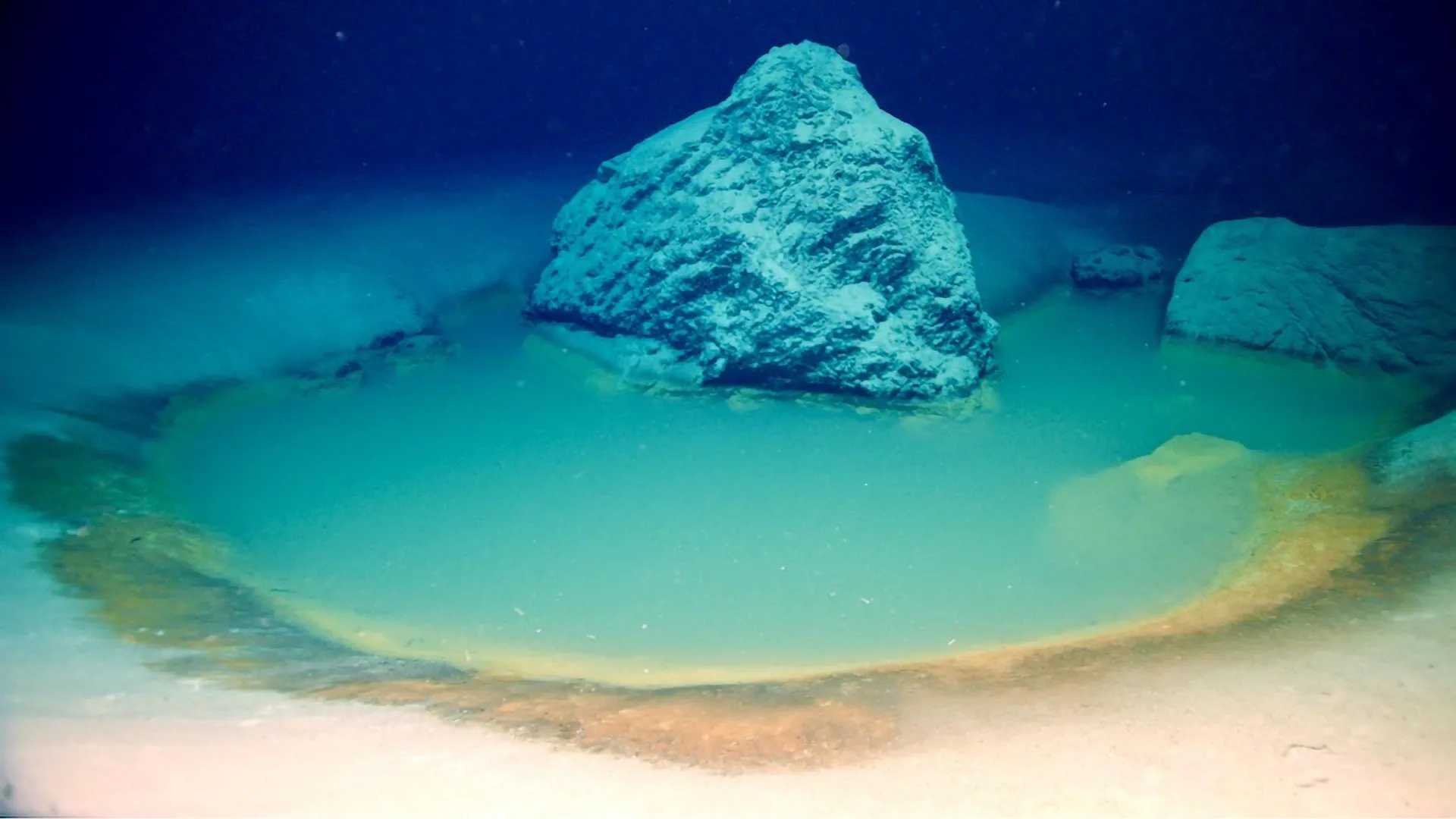
More than a kilometer under the Red Sea, researchers from the University of Miami (UM) Rosenstiel School of Marine and Atmospheric Science discovered rare pools of seawater in the Gulf of Aqaba, the northernmost point of the Red Sea. These salty underwater lakes can provide clues to how Earth’s oceans formed millions of years ago and help guide the search for life on other planets.
The discovery was made by Sam Purkis, professor and chair of the UM Department of Marine Geosciences, and colleagues in collaboration with OceanX. Researchers discovered the lakes at a depth of more than one mile (1,770 meters) using a remotely operated underwater vehicle (ROV) launched from the OceanXplorer, an advanced research vessel equipped to probe some of the world’s most inaccessible places.
Until we understand the boundaries of life on Earth, it will be difficult to determine whether alien planets can host any life,” said Purkis. “Our discovery of a rich community of microbes that live in extreme environments can help trace the boundaries of life on Earth and can be used to search for life elsewhere in our solar system and beyond.”
Life thrives in extreme underwater lakes
Brine lakes are among the harshest places on our planet. Their water is very salty, has an unusual chemical composition, and is completely devoid of oxygen. Despite these seemingly unfavorable conditions, ponds support abundant microbial life. Previous research on the microbes that live in the salty pools of the Red Sea has even identified organic molecules with anti-cancer potential.
The findings, published in Communication Earth and Environmentmark the first documented discovery of saltwater lakes in the Gulf of Aqaba. Remarkably, the researchers almost missed them.
“We were very lucky,” Purkis said. “The discovery came in the last five minutes of a ten-hour ROV dive that we could dedicate to the mission.”
Hidden records of ancient tsunamis and earthquakes
Beyond their biological importance, the lakes serve as natural repositories of the region’s geological history. Being close to the coast, its high salt water and lack of oxygen help preserve evidence of tsunamis, heavy floods and earthquakes that occurred in the Gulf of Aqaba thousands of years ago. Regional tectonic activity has produced numerous faults and rifts in this part of the gulf.
In early 2022, Purkis and his colleagues found evidence of a 500-year-old underwater landslide that may have caused a massive tsunami. Understanding the regional history of such events can have important implications for coastal development in Egypt and Saudi Arabia.
The study, titled “Discovery of deep sea pools of NEOM Brine in the Gulf of Aqaba, Red Sea,” was published on June 27, 2022, Communication Earth and Environment.
The research team included Sam J. Purkis, Hannah Shernisky, Peter K. Swart, Arash Sharifi, Amanda Oehlert, Gaëlle Duchâtellier, James Klaus, Gregor P. Eberli, Larry Peterson, and Graham Kolodziej of the UM Rosenstiel School; Fabio Marchese and Francesca Benzoni from King Abdullah University of Science and Technology’s Red Sea Research Centre; Giovanni Chimienti from the University of Bari Aldo Moro in Italy; Andrew Craig and Mattie Rodrigue of OceanX; Jürgen Titschack from MARUM — Institute for Marine Environmental Sciences in Germany; and Ameer Abdulla from NEOM.
NEOM, a Saudi Arabian coastal development company, provided funding for OceanXplorer’s four-week research expedition.
Watch the NEOM OceanX documentary about the discovery:
Source link