Scientists examined a 165-million-year-old fossil from China and found a broad swimming tail and bony throat structures; the Jurassic mammal predecessor could eat and swallow in ways seen in modern mammals

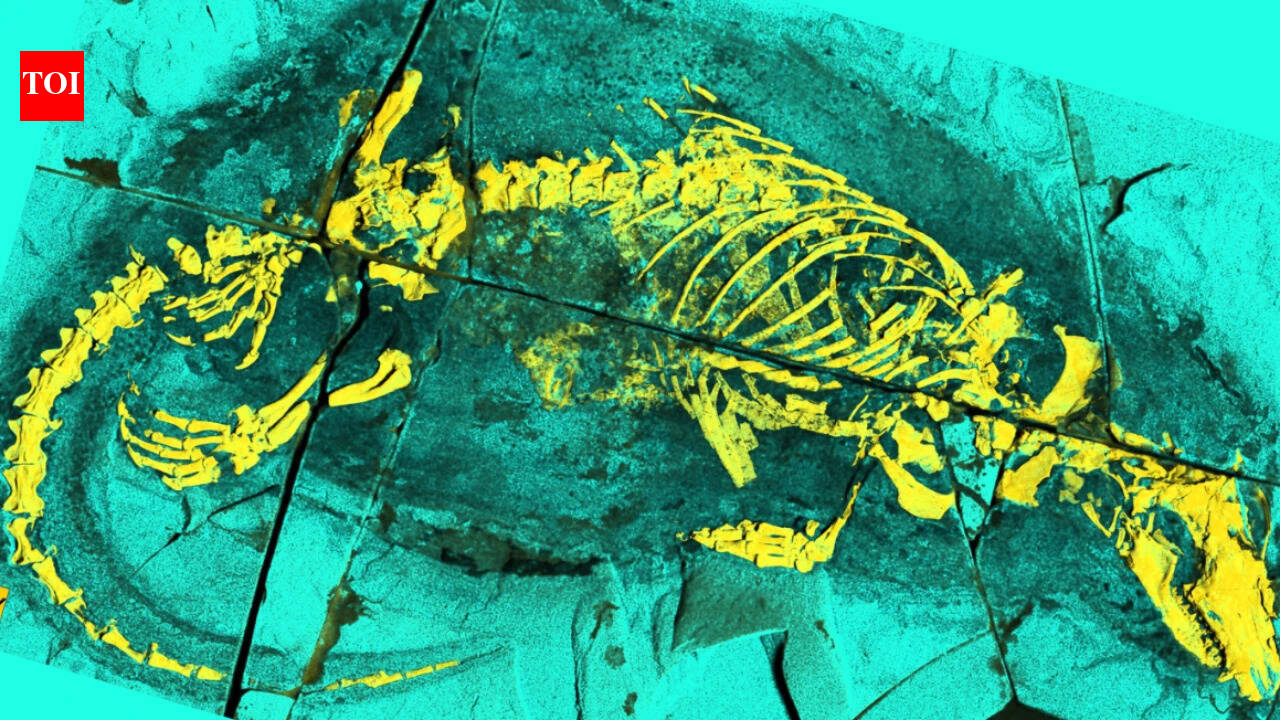
Scientists have examined 165-million-year-old fossils found in China and identified a prehistoric mammal with a broad swimming tail and throat bones similar to those found in modern mammals. The discovery suggests that some early mammalian relatives had developed methods of chewing and swallowing food millions of years before modern mammals evolved.The newly identified species, called Megacauda sungei, lived during the Jurassic period. Researchers at the University of Chicago studied its well-preserved bones and found that the animal had strong hind legs, a flat tail and specialized throat structures. Their findings were published in the journal Natureon on Wednesday.This animal was part of an extinct group called docodonts, which were close relatives of mammals during the Mesozoic era. It measured about 40 to 50 centimeters in length and weighed between one and two kilograms. Its physical characteristics suggest that it spent time on land and in water, like modern aquatic mammals.What makes the discovery important is the combination of its swimming and food properties. The fossil has soft bones that helped support the muscles involved in swallowing. According to the researchers, these structures provide the first evidence of a feeding mechanism that later became important in the evolution of mammals with different diets.
Ancient animals swallowed like modern mammals
One of the most important discoveries concerns the hyoid bones, which help connect the mouth and throat in mammals. In modern mammals, including humans, these bones form part of the structure that supports the muscles used during swallowing.The bones are arranged in a U-shaped pattern and are connected to the skull by means of small bony parts. This arrangement allows mammals to chew their food and swallow it in small pieces, rather than swallowing large pieces or whole prey as animals like crocodiles do. These structures also play a role in allowing small mammals to nurse their mother’s milk.The researchers discovered that the Megacaudahad had similar structures under its skull. The preservation was detailed enough for scientists to examine the arrangement of the bones and understand how they support the muscles involved in feeding.Zhe-Xi Luo, professor of biology and anatomy at the University of Chicago and senior author of the study, explained why this development is important.“This is a very important new evolutionary process. After mammals chew their food, be it plants or meat, they all swallow it in the same efficient and effortless way,” Luo said.When early mammals had this tool, each group could develop specialized teeth and branch out into a variety of food sources.According to co-author Peishu Li, the shape of the animal’s throat can be compared to the throat muscles of a modern opossum.
How the Megacauda moves in the water
Besides the structures of its throat, the fossils also provided evidence of how the animal moved and hunted. Its hind limbs had long outer digits similar to those of a platypus. The tail had broad, H-shaped vertebrae and a broad outline that would have helped propel the animal through the water.The skull had strong canine teeth and sharp cheek teeth capable of cutting and chewing flesh. However, the arrangement of these teeth was different from that of modern carnivorous mammals.The researchers also found small pieces of vertebrate bones preserved in the stomach of this animal. This suggests that he fed small animals, possibly including salamanders, whose fossils have also been found in the same geological deposits.Based on these characteristics, scientists believe that Megacauda followed an aquatic lifestyle, entering the water to hunt while spending time on land.The discovery adds to previous evidence that docodonts lived in different habitats. In 2006, Luo’s team identified another swimming octopus called Castorocauda. The newly studied Megacaudafossil is older and preserves more bones.“The new fossil is particularly interesting because it is older than Castorocauda. Although both docodonts lived in the same area in the water, the new fossil is complete,” said April I. Neander, a scientific artist and CT imaging specialist at the University of Chicago.
How scientists examine fossils
The fossil was found in the Inner Mongolia region of China. During the COVID-19 pandemic, study co-author Chang-Fu Zhou of Shandong University of Science and Technology transported the specimen to different laboratories for testing.Scientists used CT scans and X-ray fluorescence photography to examine the remains. Because the original slab was large, it had to be broken into smaller pieces before scanning. Neander then used the scanners to reconstruct and examine the preserved anatomical structures in detail.The researchers also compared the specimen to Microdocodon gracilis, the smallest docodont identified by Luo and colleagues in 2019. That animal, which lived at the same geological time, had bones like the mammalian hyoid.The new fossil provides further evidence that complex throat structures had already emerged among early mammalian relatives during the Jurassic period.Luo said the specimen is almost complete and helps researchers understand how these animals lived in a habitat dominated by dinosaurs.The findings suggest that important changes in digestion and nutrition occurred long before modern mammals diverged from their evolutionary predecessors. These developments later helped mammals to develop specialized teeth and adapt to a variety of food sources.
Source link