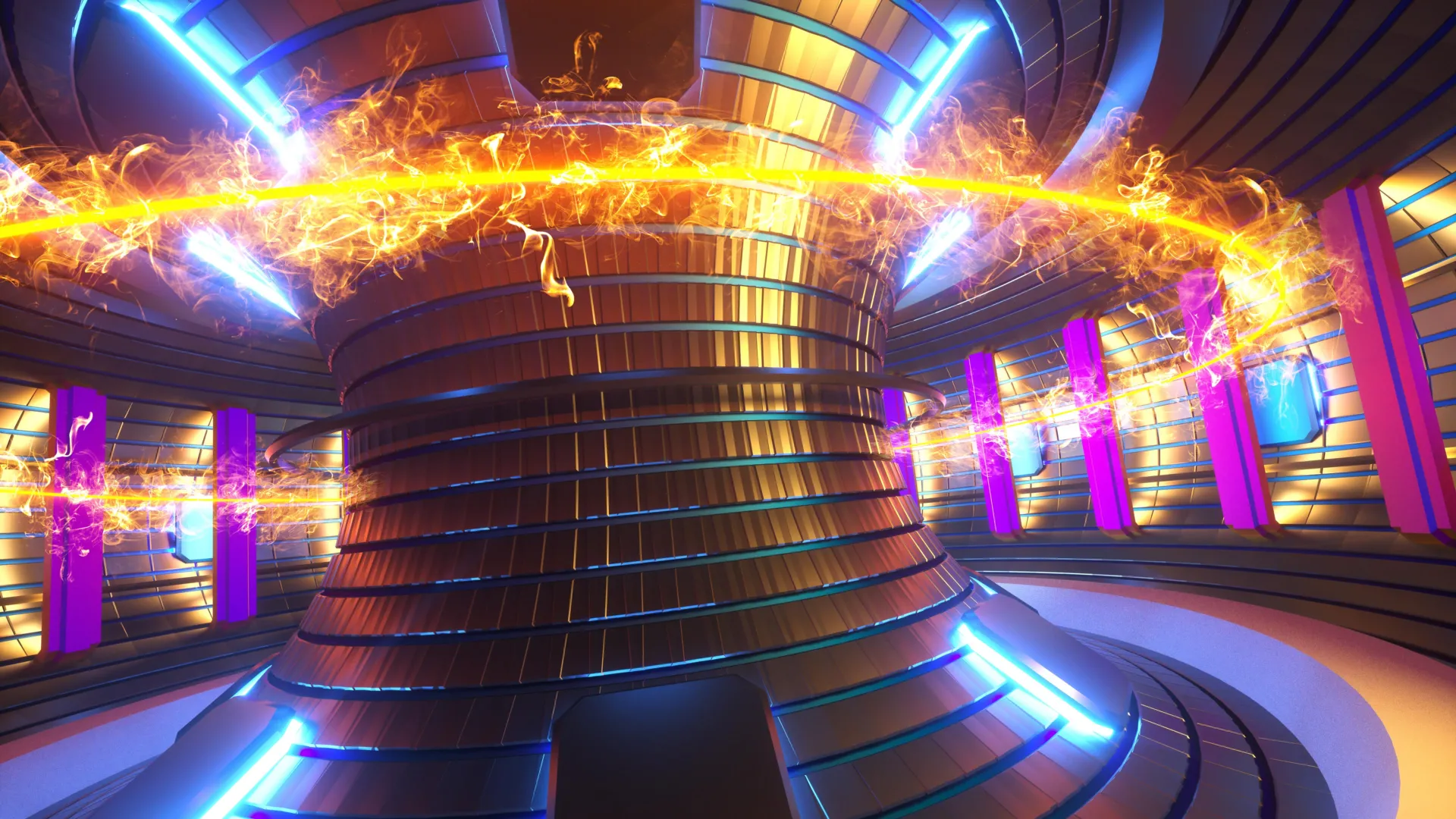
Scientists at the USDepartment of Energy’s (DOE) Princeton Plasma Physics Laboratory (PPPL) have identified a more powerful way to achieve fusion ignition, a milestone in the pursuit of efficient fusion energy. Their calculations suggest that changing the way the plasma is heated and compressed can significantly reduce the energy required to achieve self-sustaining fusion.
For more than seven decades, fusion researchers have relied on a mathematical law to determine whether the plasma can remain hot enough and dense enough, long enough, to continue fusing without additional external heating. Known as Lawson’s criterion, this equation describes the necessary conditions for ignition. However, it does not explain the most efficient way to achieve them.
Now, PPPL physicists Luis Delgado-Aparicio, Masayuki Ono, and Jonathan Menard have developed a more comprehensive version of the criterion. By combining four additional factors that influence fusion performance, they mapped a promising route to heat that would require far less energy than other methods.
Their findings were published in the journal Physical Review Letters.
The research focuses on plasma, which is often referred to as the fourth state of matter. Plasma is formed when a gas becomes so dense that its particles carry electrical charges. In fusion reactors, this superheated material contains atoms that researchers hope to fuse, releasing energy through nuclear fusion.
The main goal is to produce a burning plasma, where fusion produces enough heat to continue the process without continuous external heating. Reaching this state effectively remains one of the most important challenges in fusion energy research.
Scientists Discover Fusion Ignition Breaker
Delgado-Aparicio compares discovery to finding the most efficient route through a mountain range.
Consider that the energy requirements for the combined heat create an area dominated by a high mountain. The destination lies in the opposite direction, but there are several possible routes to reach it.
Most proposed clustering strategies successfully attempt to directly climb the mountain. They start by increasing the density of the plasma and then provide the large amount of heat needed to achieve ignition.
New statistics suggest that a different sequence may be more effective. Instead of increasing the density first, researchers can heat the plasma before making it denser. This alternative route avoids high energy requirements while still achieving the required conditions.
“A lot of companies want to climb the mountain and use a lot of energy to get there,” Delgado-Aparicio said. “Go higher than that. You get to the same place a lot smarter, and you use a lot less energy.”
Hidden Mountain Pass in Fusion Physics
Researchers have identified a very important region of this mathematical world called the Cordey saddle.
Geographically, the saddle is the lowest path between the highest elevations. In fusion physics, the Cordey saddle represents an accessible region near the boundary that separates the plasma that still needs to be heated from the plasma that can support its fusion.
To test the different routes, scientists use a measure called iQ, which compares the energy produced by fusion to the external heat energy supplied to the plasma.
For example, a Q value of 5 means the compound reaction produces five times as much energy as that supplied by the external heating system.
In an ideal plasma containing only mixed fuel, the Cordey saddle occurs at approximately Q = 5. However, real fusion systems are more complex. Impurities within the plasma and strong magnetic fields can change the position of this field, increasing the Q value required to achieve it.
Understanding how these conditions change is critical to determining whether a proposed fusion reactor can realistically achieve ignition.
A More Practical Guide to Future Fusion Answers
The findings may have implications for the design of two major types of magnetic fusion devices: tokamaks and stellarators.
Both methods use magnetic fields to seal the plasma while it is heated to the extraordinary temperatures required for fusion. Tokamaks, which have a characteristic donut shape, are among the leading technologies being investigated for the combined power plants of the future.
Research institutes and private companies are pursuing several different ways to produce electricity by combining and eventually bringing that energy to the electric grid. Identifying the most efficient ignition path can help engineers design more efficient systems while avoiding costly mistakes.
At PPPL, this project is part of a broader effort to address the scientific and technological challenges that must be overcome before commercial fusion power becomes possible, including the development of future fusion pilot plants.
One of the major advances of the study is that it examines several key physiological processes together rather than examining them separately, as previous studies have done.
The researchers identified four additional factors that may influence whether the plasma reaches and sustains ignition:
- Helium ash buildup: Fusion reactions produce helium as a byproduct. As this spent fuel accumulates, it can reduce the remaining fusion fuel and reduce performance.
- Plasma Contamination: Light and heavy impurities can enter the plasma from materials inside the reactor, disrupting fusion conditions.
- Synchrotron radiation: Electrons moving through magnetic fields emit radiation, carrying energy away from the plasma.
- Heat loss: Energy is continuously released from the plasma, and this loss can be greater as the temperature increases.
Accounting for these impacts presents a more realistic picture of the conditions to be met by future reactors.
“If you leave these results, you say the design will work well,” said Ono. “When you include them, the picture changes, and it’s very important.”
According to Ono, the goal is to develop a more reliable, widely applicable model that scientists can use to test fusion reactor designs before construction begins.
Treating the Lawson criterion as a single fixed limit underestimates physical processes that can significantly change fuel requirements. Incorporating those results early in the design process can prevent costly problems later.
“Fusion testing costs a lot of money, and you don’t want to make mistakes that you could have caught earlier,” he says.
Small Amounts of Tungsten Can Make Fusion Very Difficult
Another surprising discovery is about tungsten, a highly heat-resistant metal chosen for the inner walls of more than a dozen next-generation fusion machines.
Tungsten is attractive because fusion reactors must withstand conditions that include plasma temperatures higher than those found in the core of the sun. However, the materials also present a major challenge if even a small amount enters the plasma.
The team’s calculations show that tungsten contamination at a concentration of one part in 10,000 can almost double the pressure required to achieve fusion transport.
That’s a huge increase from a very small amount of material.
The figures were first developed into two dimensions. When the researchers extended their analysis to three dimensions, they found that the pressure required for ignition can exceed the limits at which the plasma remains stable.
This suggests that seemingly minor contamination may have major consequences for the feasibility of certain fusion reactor designs.
How Power Loss Can Help Stabilize Fusion
Surprisingly, some of the processes that make combustion more difficult can also help fusion reactors operate safely and consistently.
Scientists have long investigated the possibility of thermal “runaway” instability. This happens when the heat from fusion increases the rate of the reaction, producing more heat and potentially creating a self-reinforcing cycle.
The researchers found that the energy loss within the plasma can naturally counteract this effect.
Although these losses increase the difficulty of reaching the temperature, they also provide a balancing effect that can allow the burning plasma to maintain a stable operating state without frequent adjustments.
This balance can be valuable in future reactor designs.
(Unlike a fission power plant, the fusion system only captures the fuel seconds at a time, so losing control means the plasma cools down and combustion stops instead of anything worse.)
Liquid Lithium and Advanced Fuel Can Improve Fusion Performance
The study also identifies technologies that can help overcome some of the obstacles revealed by the statistics.
Another possibility includes coating the inside of fusion reactors with liquid lithium, an approach PPPL researchers have been investigating for years.
These holes can help prevent the tungsten from entering the plasma while reducing heat loss, making it easier to maintain the extreme conditions required for fusion.
Another promising method uses spin-polarized fuel. This involves adjusting the atomic nuclei so that their spins are aligned before fusion takes place, which can increase the rate of fusion reactions.
Together, these strategies could improve the performance of future reactors and make the path to heat more accessible.
What’s Next for the New Fusion Strategy?
Despite the promising results, the proposed preheating method has not been experimentally demonstrated.
The research is theoretical and relies on statistical calculations rather than direct measurements. Existing fusion experiments have not yet reached the temperatures associated with Cordey’s saddle, preventing scientists from testing the predicted trajectory under those conditions.
The PPPL team plans to investigate this method further through digital experiments, using computer-based simulations to test whether heating the plasma before increasing the density can bring the expected benefits.
If future studies confirm the calculations, the findings could provide an important basis for designing more efficient fusion systems and help researchers make better decisions about reactor design.
“Although more research is needed, we are pleased with these results, and they suggest a clear path forward for future research in this area,” said Munnard.
The work was supported by the DOE Office of Science, Office of Fusion Energy Sciences, under contract DE-AC02-09CH11466. Additional support came through the 2015 Fusion Energy Sciences Early Career Award, the 2018 Diagnostic Innovation and Development award, and the 2021 and 2021 and 2025 Long-Pulse Tokamak Research Programs.
Source link