
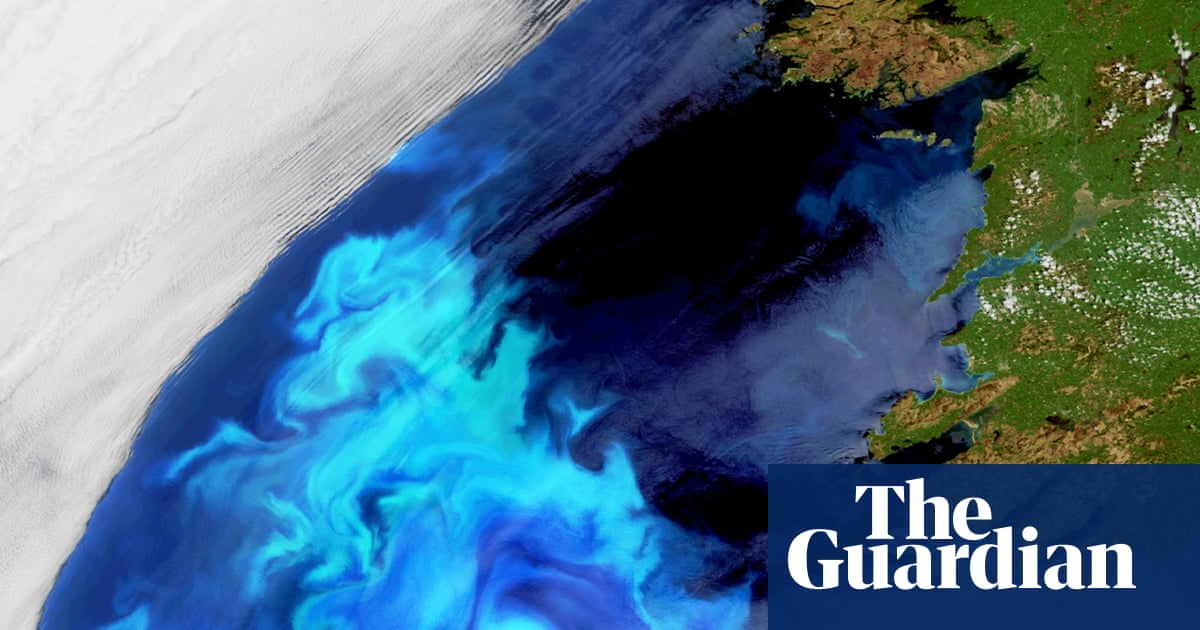
Warming seas around the UK and the wider north-east Atlantic could disrupt marine food webs, weaken marine life and threaten food security by 2050, according to a four-year study.
Scientists who have revealed the impact of climate change on four key groups of marine organisms vital to maintaining the region’s marine ecosystems say their results challenge the notion that in central areas, such as the UK, marine biodiversity is likely to increase globally.
Instead, their predictions highlight predator imbalances that could “reshape the marine environment” in unexpected ways, they say.
The seas around the British Isles, particularly the southern North Sea, have been identified as “sea climate hotspots”, one of 20 worldwide that have warmed the fastest in 50 years.
The new projections, under a scenario of 3C (5.4F) of warming by 2100, found that although fish and invertebrates in the ocean may vary significantly within a century, important groups of plankton lower in the food chain are likely to decline. This imbalance, the report’s authors say, can disrupt marine food webs and weaken the health and resilience of marine ecosystems.
“What surprised us was that warming does not increase or decrease biodiversity globally,” said Elena Couce, a marine biologist at the Center for Environment, Fisheries and Aquaculture Science (Cefas), a British government agency, and co-author of the study.
“Although some groups moving up the food chain, such as fish, may gain species in the northeastern parts of the Atlantic, important groups of plankton that support marine ecosystems are expected to lose species,” he said.
The research, led by Cefas and published in Science Advances, involves an international team of researchers from the University of East Anglia, the Marine Biological Association, UiT the Arctic University of Norway, the Royal Netherlands Institute for Sea Research and the Technical University of Denmark.
“When things get really hot, all the species from the equator will move north and south,” Cource said. “The UK is in the middle. So we expected diversity to increase, because you get more diverse species from the south than you lose from the north.”
A previous Cefas study looking at important fish species suggested warming in northwestern European waters could lead to climate “winners”, such as anchovies, seabass and sardines. Such conditions, however, are not very suitable for the “losers” of the climate, including Atlantic cod, haddock and coley.
The current study, which focuses on ecosystems in UK waters and the wider north-east Atlantic including Ireland and France, found that within a century, the diversity of fish and marine fauna could increase by around 12%, while the diversity of phytoplankton and zooplankton could decrease by around 3% and 7%, respectively, by 2050.
“If the diversity of predators increases while the diversity of animals falls, that has the potential to disrupt the food chain,” said Lily Greig, a marine biologist at Cefas who also participated in the study. “Our results show that climate change can change the diversity of marine life unevenly throughout the food web, and that the gains of some groups do not necessarily mean that the ecosystem as a whole is becoming resilient.”
By identifying where biodiversity was changing most rapidly and which parts of the ecosystem were most at risk, the study could provide an “early warning system” for potential ecosystem change, the researchers said. Work has been submitted to the government’s review of marine protected areas, which is looking at ways to control fishing.
“Policymakers have the authority to try to preserve or increase biodiversity,” said Couce. “What we’re trying to tell them is that climate change is changing biodiversity, and you have to take that into account before making other management plans.”
Scientists used extensive long-term data sets and advanced machine learning techniques to determine the relationship between biodiversity and climate change, enabling them to predict climate-driven changes in biodiversity up to 2100.