Aristotle’s Quote of the Day, “In life, first, have a definite, clear and practical vision; a goal, a goal. Second, have a need..”

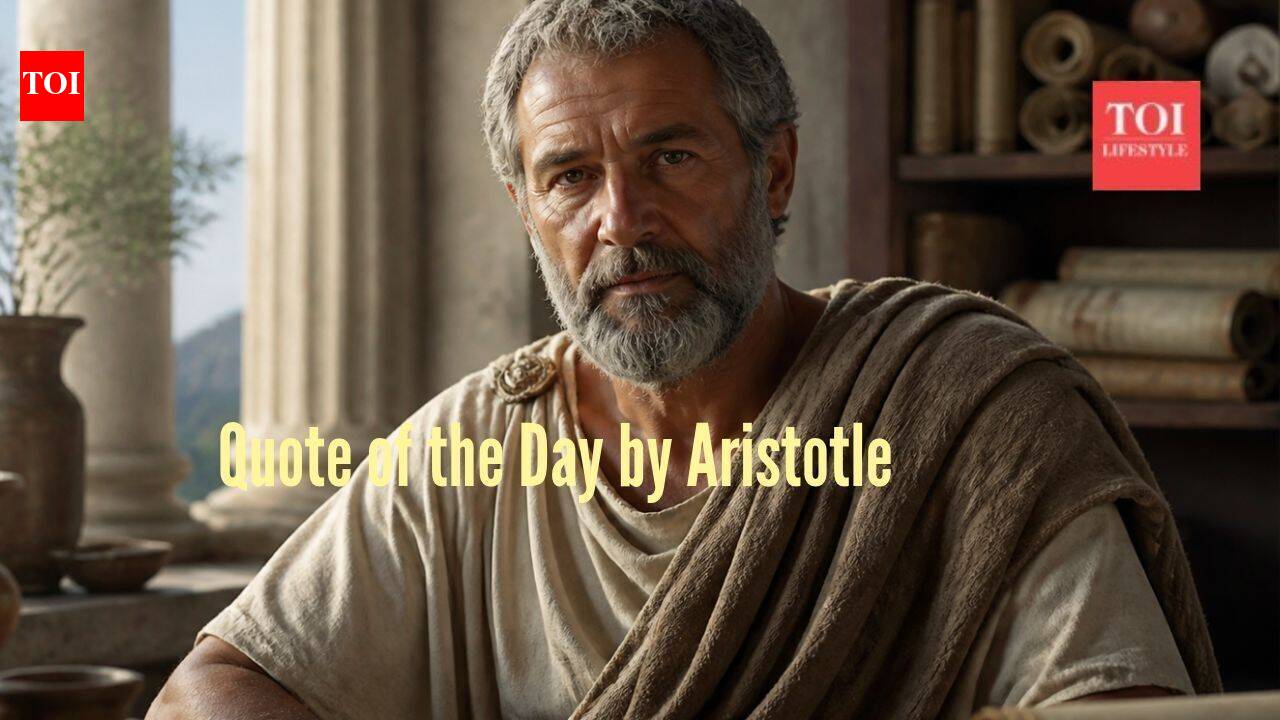
Aristotle needs no introduction. His legacy is timeless. Aristotle was one of the greatest philosophers, thinkers and intellectuals in human history. Born in ancient Greece more than 2,300 years ago, he made a remarkable contribution to philosophy, science, politics, ethics, biology, literature and education. His ideas helped shape the development of Western civilization and influenced generations of scholars, scientists, religious thinkers and political philosophers.He was so influential that his thoughts were central to intellectual debate for centuries and many of the questions he posed are still controversial today.Aristotle was born in 384 BC in Stagira, a city in northern Greece; so he is sometimes called a Stagirite. His father, Nicomachus, was a physician in the service of King Amyntas III of Macedonia. Aristotle’s father was a physician and this early exposure to medicine and naturalism may have influenced his lifelong love of biology and natural science. Orphaned as a child, Aristotle was raised by a guardian. As he grew older his intellectual curiosity and interest in learning became more evident.At the age of 17 or 18 he went to Athens, one of the most important intellectual centers of the ancient Greek world, to study at Plato’s Academy. Plato was one of the greatest philosophers of his time and had a great influence on him. He attended the Academy for about 20 years, first as a student, then as a teacher and scholar. He had great respect for Plato, but in the end he developed his own philosophical views that were different from those of his teacher.Plato was more concerned with relevant forms that existed outside the physical world, while Aristotle believed that knowledge could be gained by studying the world around us. He believed that in order to understand the truth one must use observation, evidence and logical reasoning. This difference in approach would be one of the biggest differences in the history of philosophy.His relationship with Alexander the GreatIn 343 BC, Aristotle was invited by King Philip II of Macedon to teach his son, Alexander, later known as Alexander the Great – this was one of the most interesting chapters in Aristotle’s life. The young prince was tutored by Aristotle in subjects such as philosophy, literature, politics, medicine and ethics. He also taught him Greek culture and the books of important scholars, especially Homer.The exact nature of the relationship and the extent of Aristotle’s influence on Alexander is a matter of historical debate, but this connection brought together two of the most extraordinary figures of the ancient world: the one who would come to change the political world through his military victories, and the one who would change the intellectual world through his philosophical and educational contributions. Aristotle eventually returned to Athens after Alexander had begun his wars.Lyceum foundationIn 335 BC, Aristotle opened his own school in Athens, called the Lyceum. It was an important center for philosophical discussion, scientific research and intellectual education. Unlike most traditional educational institutions, Aristotle’s school gave students the opportunity to explore a variety of subjects through observation, discussion, research and reasoning in a structured way.His disciples were known as Peripatetics, a term that has come to be associated with the practice of walking around while discussing philosophical matters. Aristotle and his students studied impressive subjects at the Lyceum including mathematics, astronomy, politics, zoology, botany, literature and metaphysics. Aristotle believed that education should help develop the ability to think critically and understand the world, not just memorize information. His methods provided the basis for systematic academic inquiry.His major contributions to philosophyAristotle’s philosophical ideas were amazing because he tried to understand almost every aspect of human life.One of his most important works was the Nicomachean Ethics, in which he discussed the meaning of happiness and the virtues necessary for a good life. He thought that the main purpose of human life was to achieve eudaimonia, a Greek word often translated as prosperity or well-being. He asserted that true happiness does not come from wealth, happiness or social recognition alone. Rather, it came from having good character and doing good things such as courage, honesty, generosity, patience and wisdom.He also suggested the idea of the Golden Mean, that goodness is often found between two extremes of evil. Thus courage stands between cowardice and rashness; generosity between carelessness and corruption. His philosophy encouraged people to cultivate balance, exercise good judgment and develop habits that would help them become better people.Aristotle was among the first to learn how to think. He developed a logical system of reasoning, and explored the ways in which conclusions could be reached from the premises mentioned.His work on syllogisms provided an important foundation for the development of systematic reasoning. He believed that knowledge could only be gained through clear thinking and logical reasoning.Aristotle’s “Politics” is a study of the nature of government, citizenship, and the responsibilities of individuals in society. He thought that humans are inherently social and political animals, able to exercise their power in social life. He studied various forms of government. He looked at the good and bad of these governments. He also thought that the purpose of political society was to promote mutual benefit and to set goals by which citizens could live a fulfilling life.Aristotle also made a lasting contribution to literary criticism in his book Poetics. Here he studied tragedy, storytelling, character development and the emotional impact of dramatic literature. Most influential was his discussion of catharsis, which is often taken to mean the emotional release or clarity that audiences experience in tragedy. His ideas still inform discussions of storytelling, theater, cinema and literary criticism.LegacyAristotle was not just a philosopher who pondered the world. He was also a keen naturalist. He studied animals, noted their physical characteristics, classified different species, and tried to understand their behavior and reproductive processes. His biological writings are particularly notable for their scope and insight. Some of his scientific discoveries were later corrected, but his systematic approach to the study of living things influenced natural history for centuries. He also worked on physics, astronomy and metaphysics. Many of his scientific explanations were later replaced by modern ones, but his insistence on investigating fundamental questions helped shape the intellectual traditions that followed.Anti-Macedonian sentiment arose in Athens after the death of Alexander the Great in 323 BC. Aristotle was associated with the Macedonian royal family and was politically unpopular, and even accused of disrespect. He left Athens and moved to Chalcis where he spent his last days. Aristotle died in 322 BC, at the age of 62.Quote of the Day“In life first, have a definite, clear vision that works; a goal, a goal. Second, have the means necessary to achieve your goals; wisdom, money, things, and ways. Third, prepare all your means to achieve that.” It is a profound, logical quote widely attributed to Aristotle.These lines teach us a profound lesson about the relationship between ambition, preparation and purposeful action. This quote reminds us that success is rarely an accident. You can’t just dream and do something or hope for a better life. We need to know what we want, understand what it will take to get there and carefully plan our resources and efforts in making that desire a reality. It means that meaningful success begins with a clear purpose and is achieved by using available resources wisely.The first part of this quote says: “First, have a definite, clear working vision, a goal, a goal, this is probably the most basic rule for finding anything meaningful in life.” Before we start our journey, we need to know where we are going. The greatest effort, even the most sincere effort, can go around without the destination. Everyone has dreams and wishes and desires but not everyone takes the time to clarify them. Someone might say that they want to be successful, financially independent or happy. But these are general wishes, not specific goals. What does success look like to them? What does financial freedom look like? What would make them feel satisfied?But it is necessary to distinguish between wanting and having a specific intention. A dream gives us something to hope for, a goal gives us something to work towards. Ambition needs clarity to provide direction. This helps us prioritize our decisions, avoid unnecessary distractions, and see if our actions are bringing us closer to where we are going. The second part of this quote is as follows: “Second, have the necessary means to achieve your goals; wisdom, money, things and means. In this passage Aristotle draws attention to a fact that people often forget: the desire for something is not the determination to get it. Ambition must be supported by wealth, knowledge and power. That is why preparation is as important as ambition, Aristotle considers wisdom as one of the important ways to succeed.
Source link