An unknown object excavated from a British cave in the 19th century has finally been identified as a 15,000-year-old seal tooth pendant; researchers say it provides clues to ancient human culture and distant connections |

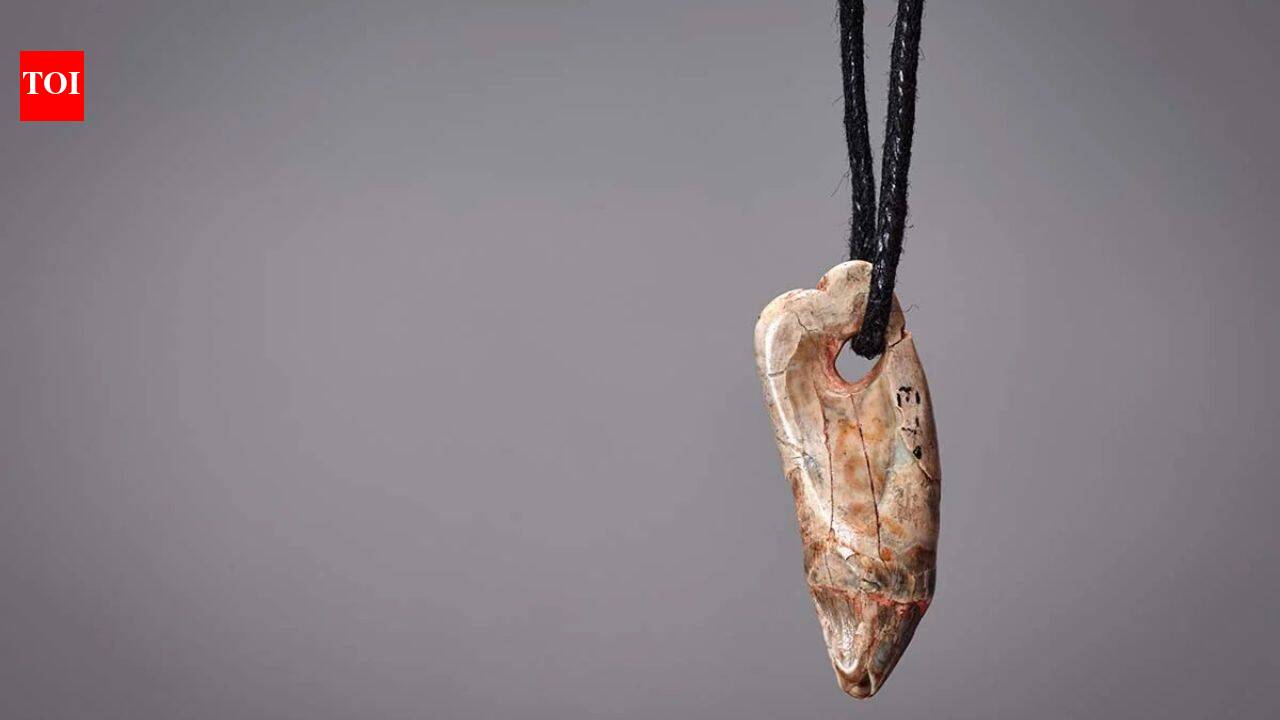
A mysterious object found in a British cave during a 19th-century archaeological dig has finally been identified as a piece of prehistoric jewellery. The researchers identified the artefact as a pendant made of gray seal tooth, dating back about 15,000 years. The discovery, made at Kents Cavern in Devon, provides new insights into how people living at the end of the Ice Age created personal ornaments, traveled long distances and maintained contact with communities outside their immediate surroundings.
15,000 years old a tooth pendant he remained unknown for more than a century
The unusual artefact was discovered in 1867 during excavations at Kents Cavern in Torquay, Devon. The archaeological work was led by William Pengelly, whose investigations between 1865 and 1880 helped establish systematic methods of recording archaeological finds in Britain.Despite the discovery and other prehistoric discoveries, this small tooth-shaped object did not attract much attention. At first it was believed that it came from an animal like a badger, wolf or beaver. Its true nature remained uncertain for over 150 years.According to the Natural History Museum, a renewed examination of the museum’s archaeological collections has finally returned an overlooked object. Researchers from the Natural History Museum and University College London (UCL) revisited the artefact using modern scientific techniques to understand its origin and purpose.Their investigation found that it was made from the tooth of a gray seal, scientifically known as Halichoerus grypus. The study, published in the journal Quaternary Science Reviews, places the pendant at about 15,000 years old.The find is particularly important because items made from seal teeth are very rare in prehistoric Britain.
What did the researchers find about the creation of the pendant
The researchers also examined how the tooth was prepared and whether it was actually inserted by someone.As explained by UCL, the team used non-destructive techniques, including high-powered microscopy, 3D-modelling and micro-CT scanning. These methods allowed them to study the object’s surface, internal structure and manufacturing marks without damaging the fragile artefact.An examination revealed that the tooth had been deliberately shaped. Most of its roots had been removed or cut down, making it thinner and smoother than its original shape.A small hole was also drilled into the remaining root. According to the Natural History Museum, these marks indicate that the sharpened flint tool was repeatedly thrown against the tooth when it was set. This would require a lot of care because the root could easily split during the process. The hole provided space for the string to pass through, allowing the tooth to hang from a necklace or bracelet.The researchers also cited evidence of long-term use. The surface was rubbed and smoothed, polished, and the original round hole had slightly changed into an egg shape due to the friction of the thread inside. These details show that the pendant was worn for a long time.
Why inland discovery is important to understanding ancient connections
One of the most interesting features of the find is the place where the pendant was found.Kents Cavern is located inland, and the coast was far away when the decoration was made. According to UCL, the ancient coastline was up to 125 kilometers from the cave at that time. This raises questions about how an object made from a marine animal made it to such a remote location.Researchers have suggested two possible explanations. The owner of the log may have traveled long distances, perhaps following migrating animals or between different areas. This decoration could be changed between communities.The Natural History Museum says that ancient people were not always confined to their dwellings. The movement of animal remains, ornaments and other objects shows that societies were able to communicate over long distances. The pendant provides evidence of how objects and cultural practices may have moved between groups during the Upper Palaeolithic.
Similar discoveries reveal extensive cultural links across Europe
The Devon finds also fit a wider pattern of prehistoric ornamentation across Europe.According to the Natural History Museum, the period between about 21,000 and 13,000 years ago saw an increase in the use of bones and teeth from marine mammals to produce decorative objects.Archaeological discoveries at Las Caldas in Spain, for example, include several artifacts made from seals and whales. The site is located more than 40 kilometers inland, suggesting that marine material was transported from coastal areas.The researchers also identified representations of marine mammals in Gönnersdorf in Germany, where seals were carved into rocks hundreds of kilometers from the sea. Another nearby site, Andernach, contains a similar inscription next to a whalebone artefact.UCL notes that the newly identified Devon pendant is the first confirmed example of a Magdalenian seal-tooth pendant in the British Isles. Similar objects have been identified at archaeological sites in France and Spain.Natural History Museum human evolutionist Dr Silvia Bello, who co-authored the study, suggested that the pendant may have had a social or symbolic role. It may represent the identity of its owner or show an association with a community familiar with coastal areas.Only 4 other tooth pendants of this period are currently known, making the Devon example rare.
Source link