A woman who works in an insurance company has a side business selling coconuts and brings in Rs 1.17 crore; taxpayer sends notice, but ITAT grants relief by refusing action to treat entire amount as undisclosed income

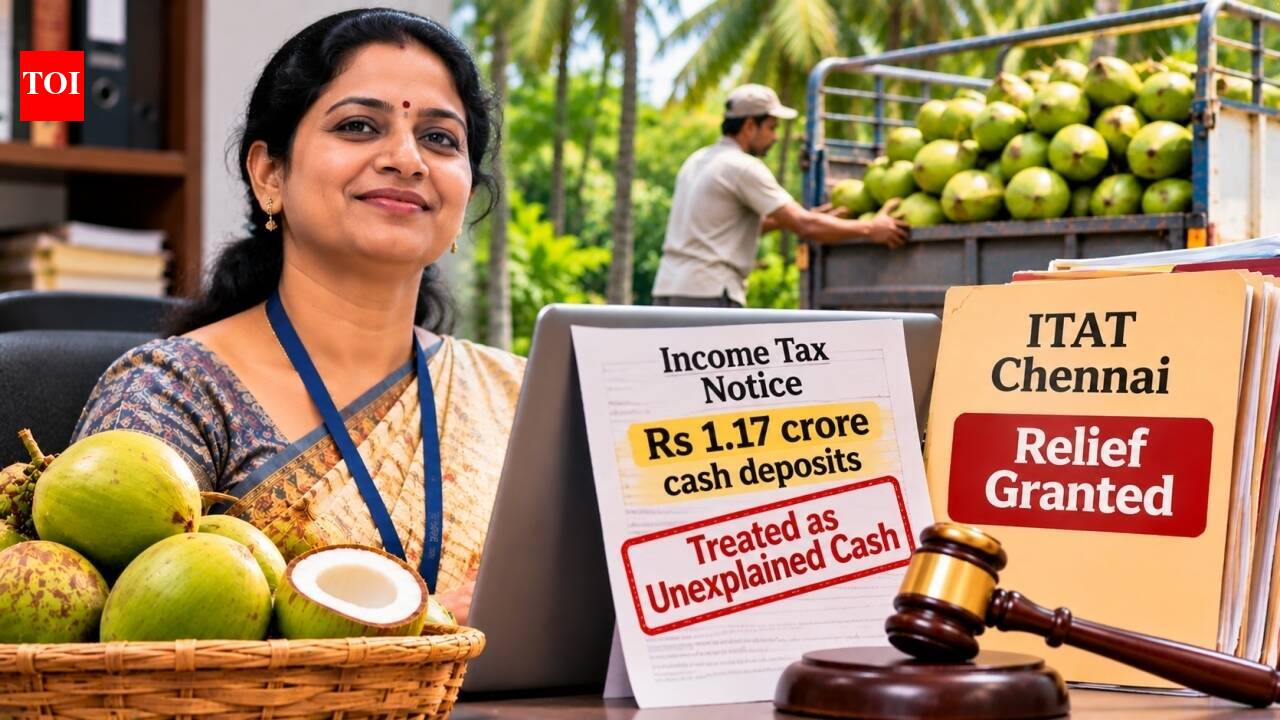
A side business of a salaried insurance worker landed him in an income tax dispute after he deposited Rs 1.17 crore in cash, saying the money was from coconut trading.The Income Tax Department rejected his explanation and treated the entire amount as unexplained income, adding it to his taxable income.The dispute eventually reached the Chennai bench of the Income Tax Appellate Tribunal (ITAT), which examined his revised tax returns, bank statements and assurances from coconut buyers.
What is the case about
The woman was working with an insurance company when she said she had a coconut buying, harvesting and trading business in Kanyakumari district of Tamil Nadu.As part of this project, he took over coconut plantations leased from farmers and used laborers to harvest the produce. He also bought coconuts directly from other farmers before selling them in the market after removing their husks. His activities therefore consisted of harvesting coconuts from rented gardens and trading products bought from other farmers.In the financial year 2019-20, he deposited Rs 1.177 crore in his bank accounts. He further said that this money came from the receipts of his coconut business.The level of these deposits made the Tax Department to take up his case for consideration.The source of the deposit became an important question during the investigation. When the tax department issued a notice seeking an explanation, he said his business involved harvesting coconuts from rented gardens and buying fresh coconuts from farmers in nearby villages. He explained that the product was sold after semi-dehusking.At first, the woman understood that this work was agricultural. He later changed the way he reported his receipts by filing a revised income tax return (ITR-U) in 2023. In this return, he declared the receipts as business profit and provided the income under the imputation tax regime provided by Section 44AD of the Income Tax Act. He had not kept regular books of accounts or prepared financial statements.The Assessing Officer (AO) was not satisfied with his explanation and classified the entire Rs 1.177 crore deposited in cash as unexplained amount under Section 69A of the Income Tax Act.The position of the AO was that the woman failed to provide sufficient documentary evidence to show where the money came from or to support her claim that she was engaged in activities related to coconuts.In February 2024, the AO issued a show cause notice to the woman to explain why the deposit should not be treated as unexplained amount. The assessment order notes that he did not respond to this notice.However, he had included explanations in the earlier stages of the trial. The AO proceeded to add a total of Rs 1.177 to his taxable income, a decision which was upheld by the Commissioner of Income Tax (Appeals).He then appealed to the Income Tax Appellate Tribunal (ITAT), Chennai. In its order dated November 16, 2026, the court granted him partial relief.
Why a woman coconut seller got partial relief from ITAT
The court examined the nature of the bank account and the pattern of transactions and other evidence on record.Chartered Accountant Suresh Surana told ET that under Section 44AD, eligible businesses can calculate their taxable income by applying a prescribed percentage to their income, provided the applicable conditions are met.In her revised return, the woman disclosed a net profit of Rs 1,27,70,000 and a business income of Rs 10,21,600, arrived at by applying an 8% rate on the profit.Despite this disclosure, the AO classified the entire Rs 1.177 crore deposited in cash as undisclosed amount under Section 69A. The ITAT examined whether the deposits could be linked to the coconut business reported by the woman in her latest return.The court noted the pattern of transactions shown in the overdraft account. His bank statement recorded deposits on various dates, as well as withdrawals, payments made through bank channels, transfers and other debits and credits.The ITAT found that the repeated transfers of funds were consistent with his explanation that the account was being used for business purposes. However, it did not conclude that the existence of a withdrawal automatically indicated that the same amount had been returned to the account.The court also considered the assurances given by some of the coconut buyers as supporting evidence of the woman’s business. These affidavits were submitted before the Commissioner of Income Tax (Appeals) and were part of the affidavit placed before the ITAT.The court noted that the authorities did not present any direct evidence to prove that these assurances were false or that the transactions they described were false.Surana said affidavits received from coconut buyers supported the woman’s account of her business. However, the court made it clear that these documents could not independently identify the source of each cash deposit. Their importance was in providing tangible evidence that his business existed and was being run.The revised income tax form of the woman was also seen in the court’s inspection. The AO maintained a total declared income of Rs 24,96,430, including Rs 10,216 lakh reported as business income, while making a separate addition of Rs 1.177 crore as undisclosed income. The ITAT observed that the AO had not shown that the deposit was from a different source than the business income disclosed by the woman.At the same time, the court cautioned that submitting a revised return and providing income under the presumptive tax system, in itself, does not prove that the funds deposited were genuine.The origin and nature of the funds had yet to be assessed on the basis of available evidence. In this case, the ITAT found that the revised returns, bank statements and confirmations from the buyers, when considered together, supported his contention that the money came from his coconut business.The court therefore concluded that the entire cash deposit could not be classified as unaccounted for because the woman had failed to maintain regular account books.It also recognized the difference between gross business receipts and taxable profit: profit includes purchasing costs and other business expenses, and cannot automatically be treated as income earned by the taxpayer.However, the court did not give the woman full assistance. It noted that the absence of general accounts, purchase invoices, sales invoices, share registers and other supporting records meant that his actual profit margin could not be independently verified.In view of these errors, the ITAT decided to assess the additional income of the business. Directed the AO to make further addition of Rs 9,41,600 under the head “Perks and benefits of business or profession”.This figure was 8% of the Rs 1,17,70,000 deposited in cash and would be taxable on top of the Rs 10,21,600 Anita had declared under Section 44AD.The court made it clear that the additional income of approximately 8% was determined in the context of the facts and circumstances of the woman’s case. Its decision did not lay down a general rule requiring every taxpayer opting for contingency taxation under Section 44AD to pay an additional tax of 8% on cash deposits.His appeal was partially upheld. The ITAT deleted the original addition of Rs 1.177 million made as undisclosed income and substituted an addition of estimated business income of Rs 9.416 lakh.
Source link