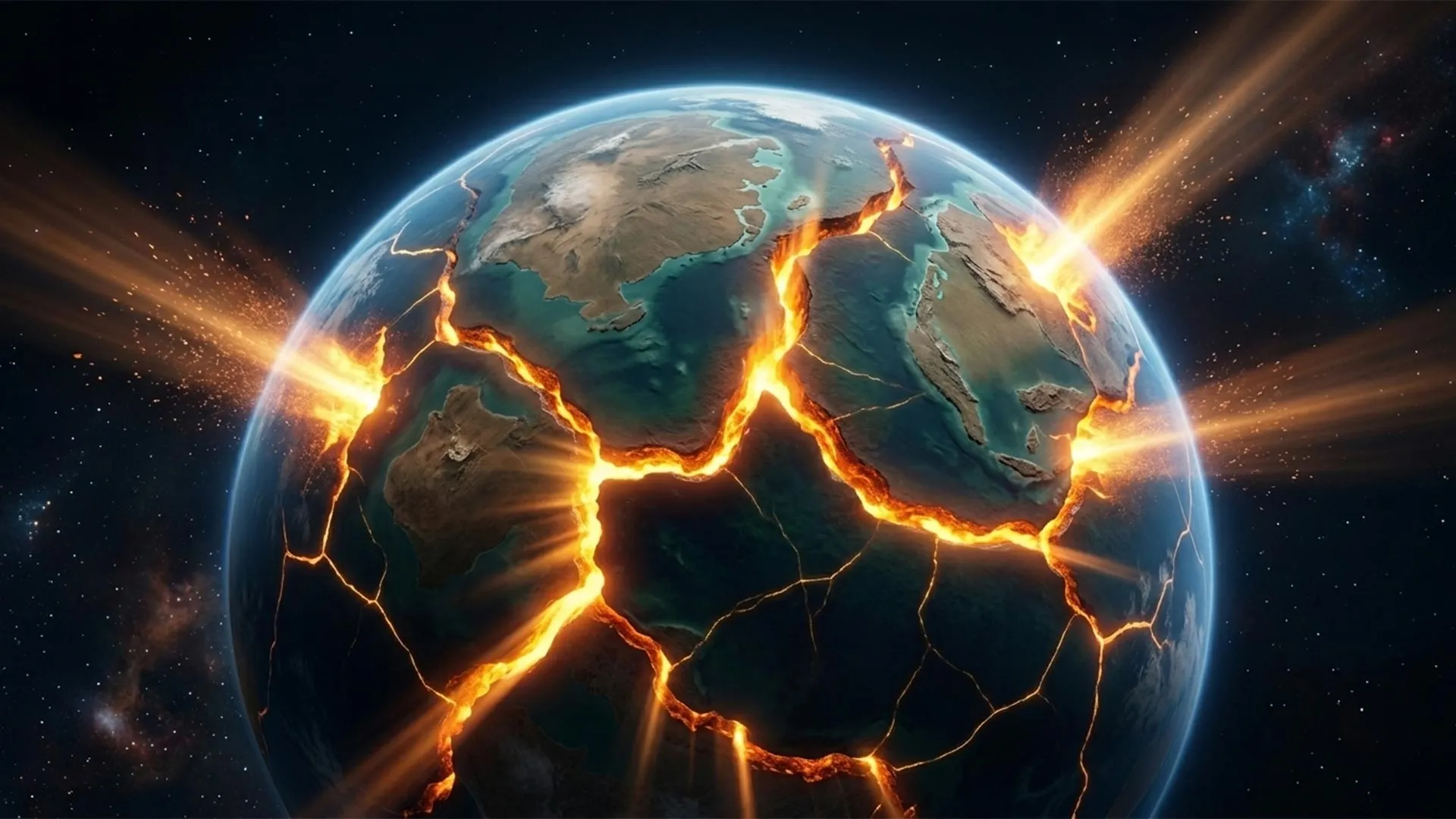
Researchers have found evidence of a profound change in Earth’s geological history. About 2.5 billion years ago, the processes responsible for the formation and reshaping of the planet’s crust underwent a fundamental change, marking the transition to modern plate tectonics.
The movement of tectonic plates constantly reshapes Earth’s continents and oceans while helping to control the planet’s climate and magnetic field over billions of years. However, finding out when this program originated has been very difficult. The process itself erases much of Earth’s geological history by recycling crustal material deep within the Earth.
A team from Curtin University has now identified a unique chemical signature in rocks collected from around the world. The disappearance of this signature about 2.5 billion years ago provides compelling evidence of a major change in the way the planet functions.
The Mysterious Chemical Fingerprint in Ancient Rocks
Lead author Dr. Janne Liebmann, Research Fellow in Curtin’s Timescales of Mineral Systems Group within the Curtin Frontier Institute of Geoscience Solutions, explained that the discovery provides a rare window into the development of the Earth’s early crust.
“New crust is often formed by melting old rocks, leaving behind a different chemical fingerprint,” said Dr. Liebmann.
“We searched for this fingerprint in thousands of rocks from around the world, spanning nearly four billion years of Earth’s history.
“We found them in rocks older than 2.5 billion years, indicating that they are from an ancient crustal lake that was formed about 4 billion years ago.
“But after 2.5 billion years ago, that fingerprint disappears from the geological record – and despite examining thousands of rocks, we never saw it again.
“That tells us something important has changed in the way the Earth’s crust is formed and transformed, marking the transition to the dynamic tectonic system we see today.”
When Earth’s Modern Tectonic Engine Emerged
According to the co-author of the study Professor Chris Kirkland, of the Timescales of Minerals Systems Group within the Curtin’s School of Earth and Planetary Sciences, the discovery brings researchers closer to understanding when the Earth established one of its most unique geological features: a tectonic plate movement system unlike anything that operates on Venus or Mars today.
“Plate tectonics is fundamental to how the Earth has evolved over thousands of years, continuing to reshape the continents and oceans and influencing the planet’s atmosphere and climate,” Professor Kirkland said.
“What makes this discovery remarkable is that we can see the fingerprints of the ancient Earth disappearing into the geological history in precise time.
“It marks a transition from the early Earth where ancient crust could be repeatedly melted and recycled in place, to a system that can move and recycle crust on a much larger scale.
“This gives us our clearest geological evidence yet of when the tectonic engine driving the modern Earth ‘turned on’.”
The study, titled “The loss of ancient crustal reservoirs marks a change in the Earth’s geodynamic regime,” was published in. Proceedings of the Royal Society A.
Source link