Kentucky collected about 5,000 discarded Christmas trees by 2026 instead of sending them to landfills; officials submerged 1,700 in one lake to replace lost underwater fish shelter

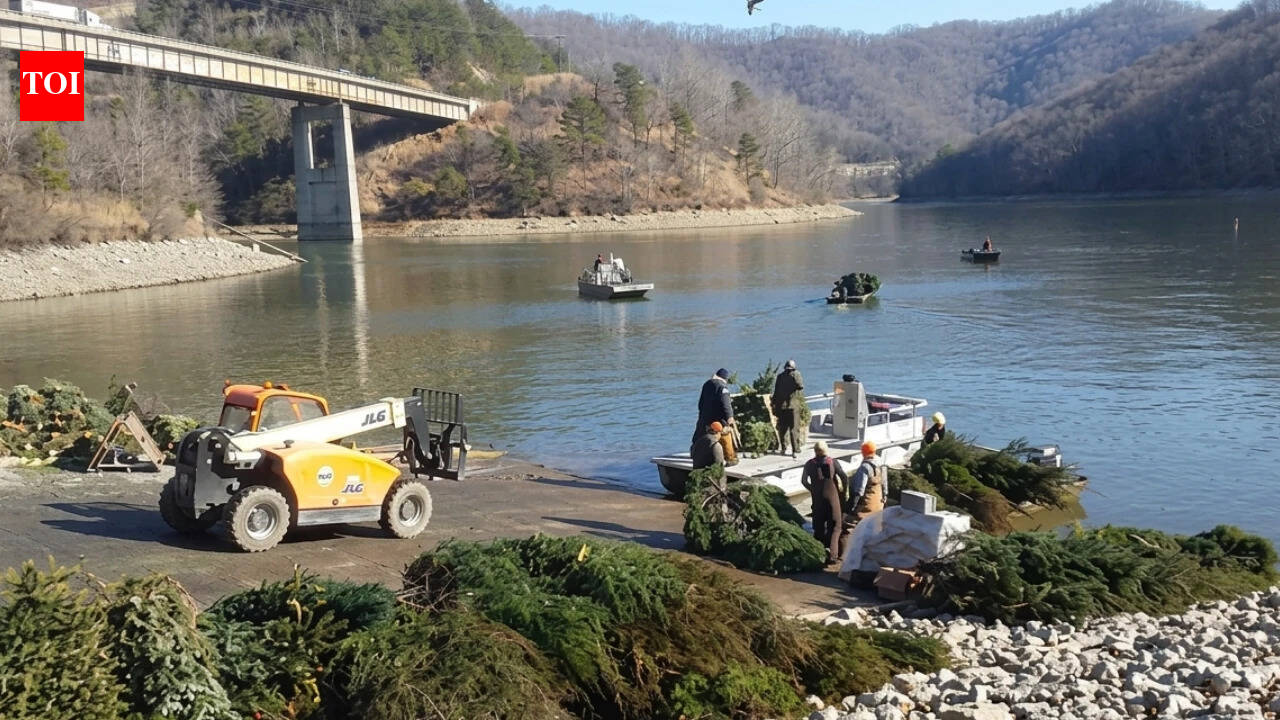
Thousands of Christmas trees that decorate homes during the holidays have found a new purpose at the bottom of Kentucky’s lakes. About 5,000 trees were donated to the state-run recycling program this year, with about 1,700 placed in Boltz Lake alone. Trees are used to create underwater shelter for fish in lakes where natural hiding places have gradually disappeared.The effort is part of Christmas for Fish, a program run by the Kentucky Department of Fish and Wildlife. Now in its ninth season, the program collects used Christmas trees and places them underwater to help preserve the habitats of various fish species.According to FOX19, the trees were collected after the last holiday season and distributed among the lakes selected for habitat restoration. Boltz Lake, in Grant County, received the bulk of the donations.But why would a lake need thousands of Christmas trees? Most of Kentucky’s lakes are artificial, and the trees and other wooden structures that once sheltered the fish have slowly collapsed. Apart from these structures, fish have few places to hide, feed and reproduce.
The problem at the bottom of Kentucky’s lakes is old
When constructing a pond, submerged trees, logs and other natural materials can provide shelter for aquatic animals. However, these structures do not last forever. As the wood decays, the spaces between the branches and logs gradually disappear. This has become a problem in Kentucky, where many artificial lakes began in the late 1950s and early 1960s.David Baker, program coordinator for Kentucky Fish and Wildlife, told FOX19 that the department has been working to replace the lost area over time.The solution involves something readily available after Christmas: discarded natural trees. Once submerged, their branches provide gaps where small fish can escape from larger predators. They also provide shaded areas and places to feed the fish. In this way, trees that are no longer needed in homes can continue to serve a useful purpose for several years.
How does it all begin?
The process begins after Christmas, when residents bring used trees to designated collection points. For the 2026 program, Kentucky Fish and Wildlife accepted donations between December 26, 2025, and January 16, 2026. There were 37 collection points across the region.However, not all types of Christmas decorations can be donated. The department accepted only real evergreen trees, stripped of all lights, garlands and decorations. Artificial trees and other plant material are not included.After collection, the trees were prepared for use in lakes and ponds. Rather than being scattered randomly, they were held together and secured using unnatural weights.These groups of underwater trees create spaces between their branches. Smaller fish may enter these areas for protection, while larger fish may congregate nearby to feed.Spencer Phillips, a fisheries biologist at Kentucky Fish and Wildlife, explained the importance of these structures in information published by the Jackson County Sun.“Every tree is important,” Phillips said. “Each tree can provide benefits to fisheries for several years, gradually restoring lost fish habitat over time. Local fishermen also benefit from the creation of reliable fishing grounds around the lost brush piles.”
Why Boltz Lake got 1,700 trees
The door does not return to all lakes annually. Instead, it follows a schedule where individual lakes usually get another cycle of trees every five to six years. This is because submerged branches eventually decay, just like the natural wood structures that are meant to be replaced.In a recent season, about 1,700 of the 5,000 trees donated were placed in Boltz Lake. The remaining donations were part of a broader program, which uses Christmas trees to improve fish habitats throughout Kentucky.By returning to different ponds over time, the department can continue to install underwater shelters as old materials degrade.
How the project benefits the fishermen
Underwater trees are also useful for people who visit Kentucky lakes for recreational fishing. Fish tend to congregate in areas that provide shelter and food. As a result, areas where trees are submerged can be areas where fishermen may find them. According to FOX19, crappie, bluegill and bass are among the fish most commonly caught near these underwater structures.The door makes it easy for fishermen to find the places where the trees are placed. Officials record GPS coordinates of underwater structures and publish the information through the department’s website and the FishBoatKY app. This means that anglers can see the locations of artificial habitats before heading out on the water.
Source link