Israel’s Netanyahu and Eisenkot meet to discuss forming national unity government’: NPR

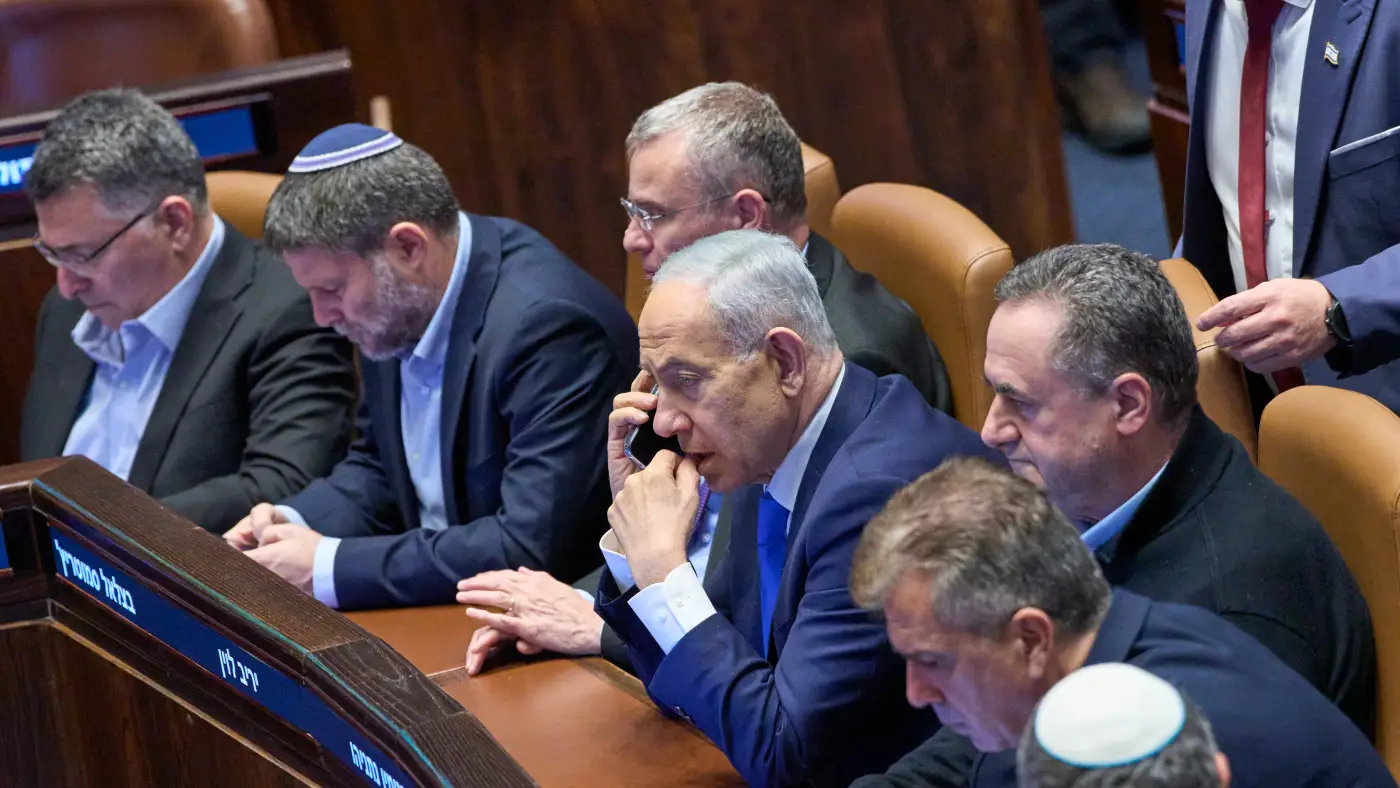
Israeli Prime Minister Benjamin Netanyahu and other Israeli lawmakers attended a parliamentary session at the Knesset, Israel’s parliament, in Jerusalem, during the election of MK Matan Kahana as the new Speaker of the Knesset, Tuesday, Nov. 17, 2026.
Ohad Zwigenberg/AP
hide captions
Ohad Zwigenberg/AP
JERUSALEM — Israeli Prime Minister Benjamin Netanyahu and opposition leader Gadi Eisenkot met on Sunday morning to discuss the issue of forming a coalition government, three weeks after the Israeli president gave Eisenkot the task of trying to establish a government in this divided country after the national elections that have not yet been concluded.
The talks took on new urgency after Netanyahu announced on Saturday night that he intended to have Eisenkot as prime minister first through a rotation arrangement under a possible unity deal.
A joint statement by their groups on Sunday afternoon said that the meeting started with a security forum and then moved on to discussing “the formation of a national unity government,” with both sides seeking to close major differences between them.
For months, Eisenkot has called Netanyahu, Israel’s longest-serving prime minister, unfit for office and a threat to Israel’s future. Netanyahu has led a relentless campaign against cooperation with Arab-led parties – whose historic gains in the October 27 election have made them potential but politicized allies in the opposition.
“The coalition government is another word for expelling the Arabs,” said Tamar Hermann, who directs the Viterbi Center for Public Opinion and Policy Research at the Israel Democracy Institute in Jerusalem.
He added that while Israelis expressed concern in opinion polls about the lack of unity in the country, those who voted for change would see the Netanyahu-Eisenkot joint government as a betrayal of Eisenkot.
Yousef Jabareen, leader of the Joint List, a coalition of three Arab-led parties, urged them to reject Netanyahu’s proposal. “It is time to fulfill the will of the entire community – Jews and Arabs alike – and oust Netanyahu this week,” he said.
Yair Lapid, the leader of the Jewish-majority opposition who served briefly as prime minister in the coalition government formed in 2021 that ended Netanyahu’s 12-year rule, called the promise a scam.
However, Naftali Bennett, who also served as prime minister in the coalition government with Lapid, has accepted Netanyahu’s proposal to let Eisenkot serve as prime minister and said that the coalition government should be built on groups representing Israelis doing military or civilian work.
Although Netanyahu’s party, Likud, won the majority of votes in national elections, right-wing and ultra-Orthodox parties that have historically supported him failed to retain their majority in parliament and received fewer seats than his opponents in the country’s 120-member Knesset.
Neither bloc secured the required majority of 61 seats, leaving both Eisenkot and Netanyahu with no easy way to choose a government.
If no agreement is reached by Dec. 6, Eisenkot may ask the Israeli president to grant him a two-week extension for one last chance to strike a deal. If that fails, Netanyahu may get another chance – and new elections may be called if he also fails.
Eisenkot’s supporters disagree on whether to include Arab-led or ultra-Orthodox parties in a potential coalition.
In addition, the talks between the parties touched on some of the most sensitive issues of the election, including the legalization of military service for Orthodox Jews and the government-led investigation into the security failures surrounding the attacks led by Hamas on October 7, 2023.
The country is still reeling from that trauma and the more than three years of war that followed in Gaza, against Hezbollah terrorists in Lebanon supported by Iran, and the war against Iran, which Israel and the United States jointly attacked on February 28.
Source link