Are Delhiites on a self-destructive mission? The psychology of firecracker obsession

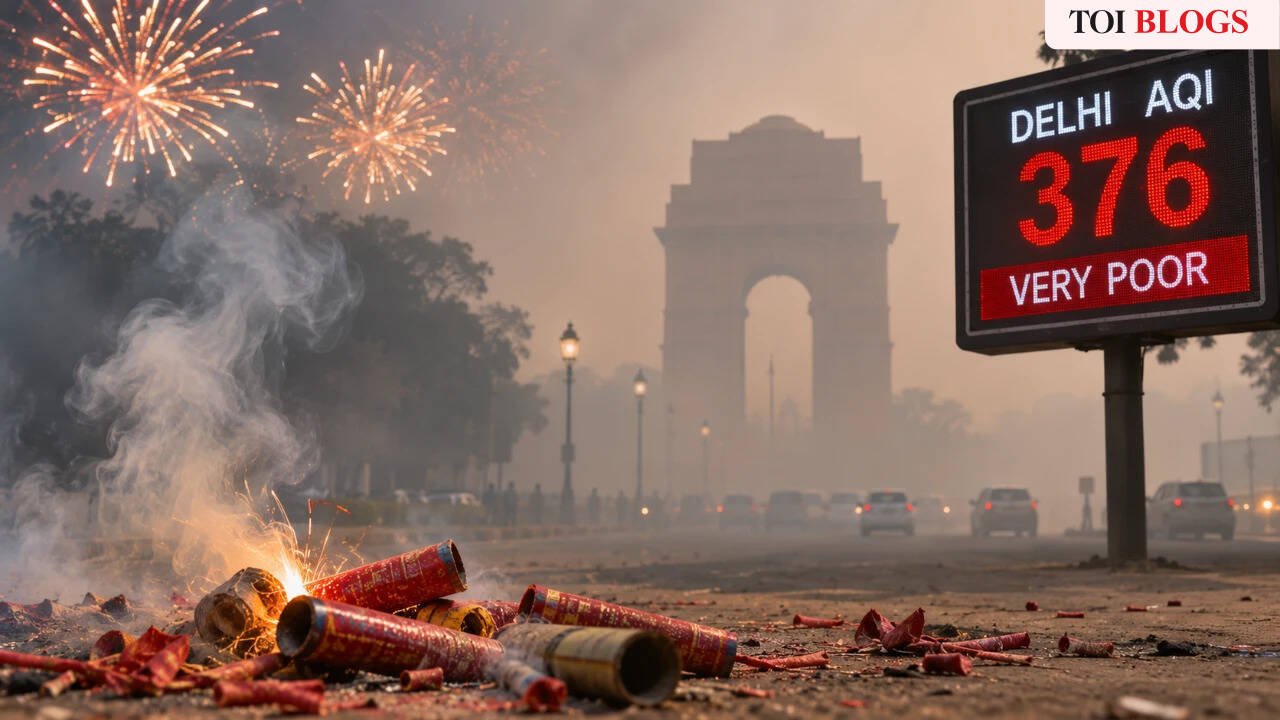
Every year, Delhi-NCR comes under environmental stress. Despite warnings and interventions, the spectacle repeats itself. A feature of this disaster is the enthusiasm with which people set off fireworks, knowing that the pollution will affect their children, parents, neighbors, pets and themselves. This year was no different: post-Diwali pollution was the worst in five years, with the Air Quality Index (AQI) at 376. What drives such behavior that threatens their health and well-being?Delhi-NCR: An ongoing environmental emergencyOf course, Delhi’s pollution problem cannot be attributed to the source. Traffic pollution, industrial activities, construction and road dust, waste burning, crop residue burning and adverse weather conditions contribute to the problem. In winter, low wind speeds and temperature fluctuations prevent pollutants from dispersing. However, fireworks add another source of particles.The legal and regulatory battle against pollutionIndia has an environmental legal framework, but the difficulty lies in implementation. The Environment (Protection) Act, 1986 empowers the Central Government and its authorized bodies to issue binding directives. The Prevention and Control of Air Pollution Act, 1981, gives powers to issue directives, including closure or regulation of industries and suspension of electricity or water supply. The Commission for Air Quality Management in the National Capital Region and Adjacent Areas, 2021, empowers the Commission to issue guidelines for effective air quality management in the NCR.Law enforcement has intervened several times to improve Delhi’s environment. In Arjun Gopal v. Union of India (2018)The Supreme Court restricted the manufacture, sale and use of conventional explosives in favor of improved and greener crackers, imposed time limits, banned certain chemicals, and emphasized their enforcement. On November 11, 2024, at MC Mehta v. Union of IndiaThe Court considered the failure to enforce existing restrictions. Delhi then imposed a year-long ban on the manufacture, possession, sale, and detonation of all fireworks in an order dated December 19, 2024, effective January 1, 2025.On April 3, 2025, a bench comprising Justices Abhay S. Oka and Ujjal Bhuyan refused to reconsider the blanket ban to allow so-called green crackers without convincing scientific evidence that the pollution effect would be minimal. The Court later allowed a temporary, controlled relaxation of green crackers during Diwali 2025, as a test provision, not a declaration that they are environmentally safe.On October 29, 2026, at Arjun GopalThe Supreme Court allowed a temporary relaxation of green crackers on November 7 and 8, 2026, under strict conditions, but restored the total ban from November 9, 2026 – the day after Diwali.In fact, ‘green crackers’ are misleading: they are less dangerous but not dangerous, and the Court admitted that particles from crackers can remain suspended for several days and affect humans and other creatures.Such orders did not help the cause by keeping the Diwali window open for misuse. It seems that the law enforcement did not have the courage to order a complete shutdown (like the order of April 3, 2025) or doubted that their orders would be followed.The psychology of mutual self-destructionThis is the most interesting aspect of the Delhi-NCR pollution problem. Why would a person do work that has an impact on an environment that threatens his life? It is tempting to dismiss behavior as ignorance or misunderstanding in society. However, psychology offers several explanations.a) Optimism bias: people tend to believe that it is unlikely that others will experience bad events. A person may agree that pollution is dangerous but believe that he or his family will not suffer. A similar situation was seen during the time of COVID-19, where some believed that the virus was dangerous but it was unlikely that they would get it or suffer any adverse effects.b) Cognitive dissonance: behavior may conflict with values. Someone who complains about Delhi’s pollution, buys air fresheners, and worries about children’s health might set off fireworks during Diwali and put it off as a one-night affair or a trivial offering.c) Herd mentality: people are influenced by others. A family that does not intend to burst crackers may participate when neighbors, relatives and children come.d) Psychological reaction: people may resist restrictions that they see as threats to freedom, asking why the government should tell them how to celebrate.e) Green Criminology examines environmental damage, environmental abuse, and behavior that harms human and human health. Traditional crime focuses on visible crimes and victims, while environmental harm involves dispersed perpetrators, widespread damage, and victims who are unaware of the cause of their suffering. Those who cause pollution are not always bothered by its worst consequences. Wealthy polluters may have access to air purifiers, air conditioners, and health care, while the elderly, children with respiratory problems, street dogs, or homeless people may suffer without protection.COVID-19 and environmental irresponsibilityThe COVID-19 pandemic provides a comparative example. Governments around the world have introduced lockdowns, mask mandates, social distancing rules and gathering restrictions, yet many have ignored them. Others thought the virus was exaggerating, feeling insecure, following misinformation, peer pressure or political self-interest, or resenting restrictions on personal freedom. The same lesson applies to Delhi’s pollution. People know that AQI is dangerous with news, advice and respiratory discomfort, but some still contribute explosives to the conditions they complain about. This indicates a failure. Compliance in public health requires more than knowledge: social norms, trust, motivation, institutional credibility and enforcement.Conclusion: The real celebration is the preservation of lifeThere is something strange about celebrating the festival of light when lives are dark. Diwali celebrates hope, prosperity and the triumph of good over evil; its essence should not be reduced to explosives. The challenge for Delhi-NCR is not only to control vehicle emissions, tribal burning and construction activities, but to change the mindset of the people who underestimate the survival of the group. The cause has been defeated by political leaders and journalists who defend explosives in the name of religion, and judges who lack the expected determination.The result is an intergenerational injustice of nature: children did not create this pollution, yet they are exposed to it during their childhood. Vulnerable groups and animals cannot protect themselves. There are costs in health care, lost productivity, and reduced work. Will citizens change their self-harming behavior before the consequences become irreversible?
Disclaimer: The views expressed above are the author’s own.
Source link