How a rare little frog has become a warning sign of nature in Madagascar | Madagascar

AAlbert Rakotoarisoa comes out of the forest to an open area in the Mangabe reserve in eastern Madagascar, he sees a number of pits dug in a swampy area, which is a sign that people have long been here to look for gold.
“I arrived a few weeks ago, but these were not there,” he said as he surveyed the damage, counting 40 holes. “I’m really disappointed.”
Rakotoarisoa, 52, patrols the area regularly on behalf of a local volunteer group and Madagasikara Voakajy, an organization that protects the island’s animals and their habitats. He has noticed an increase in illegal artisanal gold mining over the past year, as the price of the precious metal has reached record highs.
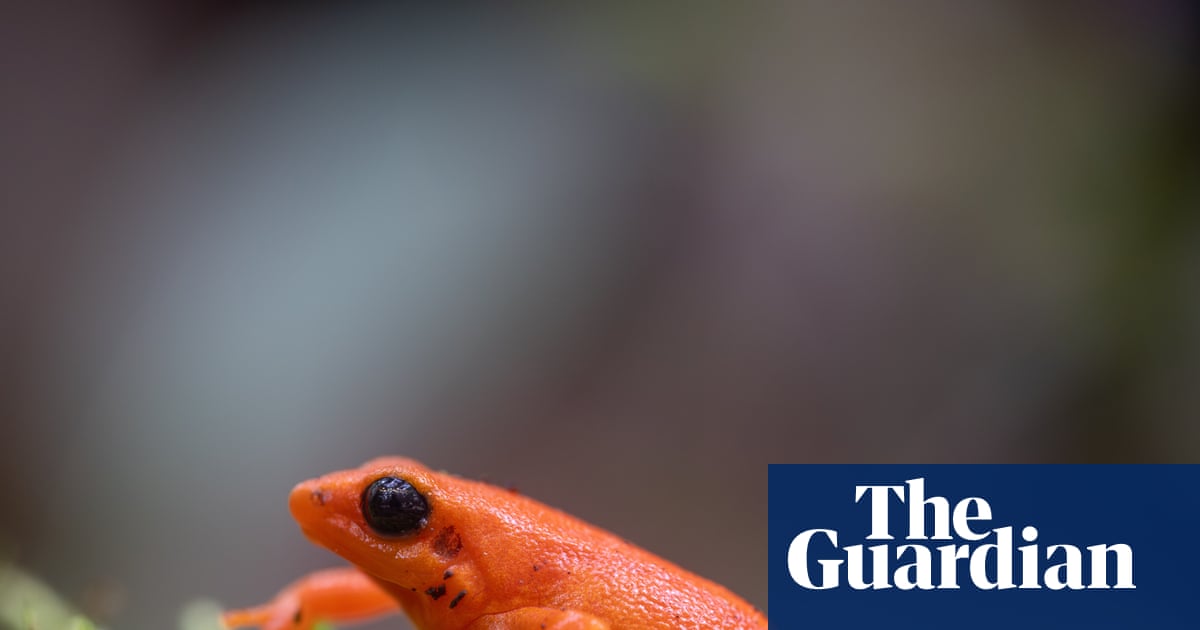
Standing on a branch of a felled tree among the holes, many of which are filled with water, he remembers this as a place that used to be the habitat of golden mantella frogs, an endangered species that is only found in two or possibly three places in a small area of Madagascar.
“I haven’t seen anyone here since 2024,” Rakotoarisoa said. “The golden manella is a source of pride for me, because I remember my father telling me when I was a child that it is only found in these parts.”
About the size of a fingernail, and bright orange in color with black eyes, this frog is considered endangered on the International Union for Conservation of Nature’s red list. There is a Malagasy saying: “Nachha misy sahona menc dia misy gold”(“There is a red frog [the golden mantella]there is gold”).
Its scientific name, Mantella aurantiacait contains the letters Au, which is also the chemical symbol for gold. Now, this species has become a warning sign of a wider threat that gold mining is affecting Madagascar as it destroys frog habitats and the population declines.
Madagascar, located off the east coast of Africa, is a biodiversity hotspot: approximately 95% of Madagascar’s reptiles, 89% of its plant life and 92% of its mammals are found nowhere else on Earth. The rate of deforestation in the country is alarming. According to Global Nature Watch, from 2001 to 2025, Madagascar lost 5.4m hectares (ha) – 14.5m hectares – of tree cover, which is 32 percent of the tree cover that existed in 2000.
To try to protect some of Madagascar’s wildlife and forests, the government had created 122 protected areas in 2015. Mangabe, which is also home to ten endangered species of lemur, covers more than 27,188 hectares. It is one of the five protected areas that have lost part of their forest and is classified as critically endangered.
Any gold mining in protected areas is illegal, explains Valéry Ramaherison, head of the extractives project at Transparency International Madagascar. Despite this, it is growing.
“Madagascar is a poor country and the situation is not getting better,” he said. “Local communities, and other authorities, are turning to small-scale mining for quick cash.”
About 80% of Madagascar’s population lives on less than $2.15 (£1.60) a day. The country is also one of the most vulnerable to climate change, with regular droughts, floods and storms causing death, displacement and damage to crops and infrastructure.
Alakambaty, a village within Mangabe, has a population of about 600 people, most of whom are subsistence farmers. It takes two to three hours – on an off-road motorcycle along a dirt track – from the nearest town. Hanta Soamalala, the mayor of the village, sits on a bench outside the primary school, overlooking the houses, rice fields, forests and surrounding hills.
“Lack of agricultural products is a big challenge here,” he said. “The main reason is the weather, people are farming but they don’t get the harvest they expected beforehand, we could predict when the rain would come, we knew when to plant, since the weather has changed, we are hit by drought, typhoons and floods, we are lost.
“We have no solution other than to accept the situation and wait for the next season.”
Samalala, 50, admits that this has made people turn to gold mining. “It’s good and bad,” he says. “Mining destroys wildlife habitats, but at least it can help people live.”
Miners told the Guardian that if they find a place where there is gold, it can take a week to collect about a gram of the metal, which is then sold in Moramanga, a nearby town, for up to 480,000 ariary (£83.40).
Most of the gold mined in Madagascar ends up in the United Arab Emirates, Ramaherison said, and there is a huge discrepancy between the officially reported gold production and the average artisanal mining. In 2023, the UN Comtrade website reported that 1,162kg of gold was exported from the country, while the national gold agency in Madagascar registered nothing.
In January, Carl Andriamparany, Madagascar’s mining minister, told a press conference that the government “has admitted that we cannot control the sector effectively and establish a strong monitoring system”.
Back in Alakambaty, Soamala went down to lead a public meeting with local people and representatives from Madagasikara Voakajy. The laws governing protected areas are read and people are encouraged to sign up with a local volunteer organization to patrol the area to detect violations.
Voahirana Randriamamonjy, who oversees the Mangabe protected area in Madagascar Voakajy, says it is difficult to find people interested in protecting the forest. The work is hard and unpaid.
He also thinks there is a lack of education and awareness about environmental issues. “Most people are not proud of Madagascar’s biodiversity and this is related to not really taking care of the environment,” he said.
“People don’t care, people are suffering and gold mining is seen as a way to make quick money, while deforestation is to grow rice for a living.”
Despite this neglect, the local organization has 120 volunteers. They are one of the few groups working with Madagasikara Voakajy to raise awareness among communities about the importance of the forest. Together, they explore, build guns, and restore the forest and wetlands where golden frogs live.
Members also try to use sustainable farming methods and have started composting and planting local plants and trees in the nursery.
About six miles (10km) from Alakambaty, the Guardian sees six golden frogs among 20-meter trees. A short walk away, just outside the protected area, the area is filled with piles of orange earth and systematic, circular holes that descend 40 meters into the ground. Each has steps cut into the side for people to descend.
As the Guardian approaches, a group of people run away. A man and a woman in their 20s come back to explain that they are doing this because their crops are always falling and they need money. They say they have no hope of finding large pieces of gold, but perhaps enough specks to supplement their dwindling income from farming.
These scenes are repeated all over the country. Earlier this month, Transparency International’s Ramaherison was sent aerial photographs of devastation by mines, such as those in Mangabe, from one of the country’s largest forests in the east. This video was posted by Alliance Voahary Gasy, a coalition of environmental organizations.
“Once someone finds a small amount of gold in the area, information will spread quickly and there will be a gold rush,” he said.
“Right now, we have local authorities that don’t have the resources to monitor or arrest people. In some cases, local authorities are also part of the illegal activity.”
In Alakambaty, Randriamamonjy accepts that there is no easy solution to prevent illegal gold mining and deforestation. He would like to see sustainable, long-term funding for conservation organizations, economic opportunities for communities, and action against people who fund illegal operations, buy gold and distribute it through illegal trafficking chains.
“If communities see tangible and lasting benefits from protecting the forest – income, strong organizations, secure rights to manage resources and a meaningful voice in decisions – while illegal mining becomes difficult to finance, sell and operate, then the benefits start to change,” he said.
Find more years of extinction here, and follow biology reporters Rebecca Ratcliffe, Phoebe Weston and Patrick Greenfield on the Guardian app for more on nature.
Source link