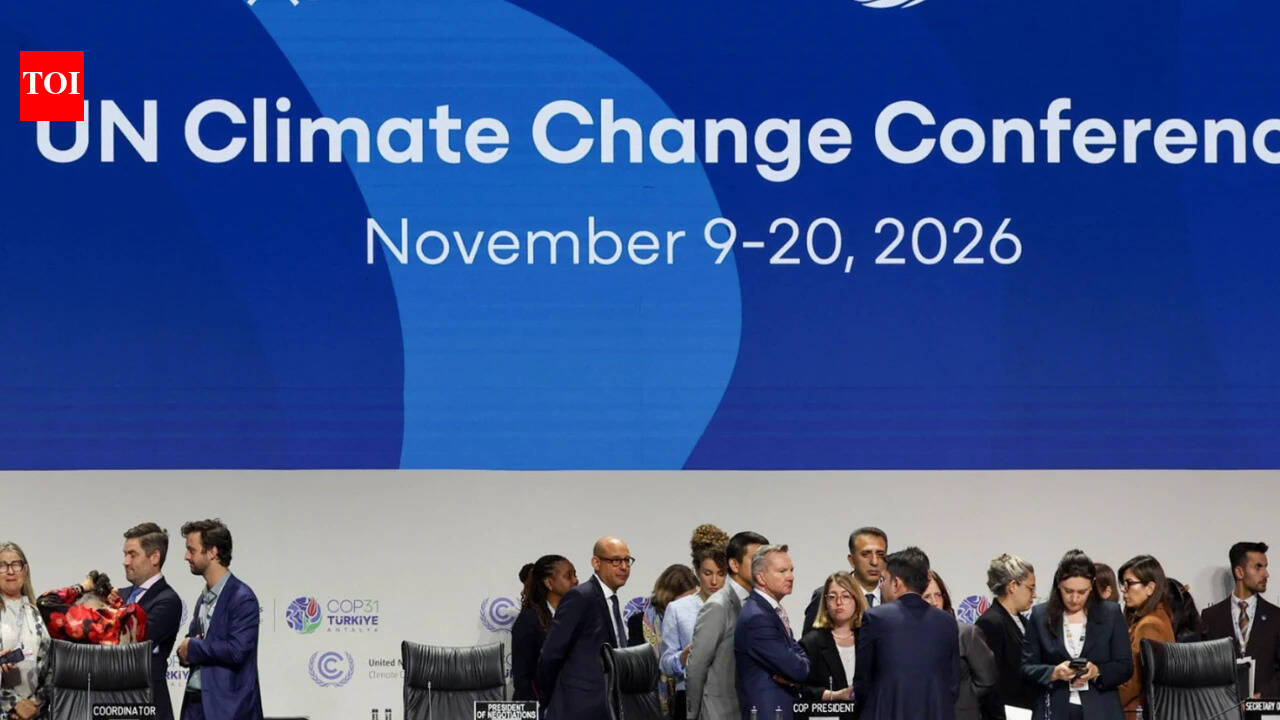
United Nations climate talks in Antalya, Turkey, ended without a major deal on Sunday after countries failed to reach an agreement on whether to explicitly mention fossil fuels in the final document. The two-week talks, which took about 48 hours of overtime, also remained divided on climate finance and other issues. The proposed agreement was rejected by several countries and the European Union because it did not include a reference to fossil fuels.Ireland’s climate minister Darragh O’Brien, speaking for the EU, said: “It is absurd that we can have climate action that has nothing to do with fuel.”The failure to reach an agreement occurred despite a large number of countries willing to accept the proposal, or reluctantly, on the grounds that an agreement was better than nothing. Russia and Saudi Arabia wanted to keep the oil out of the document.
Why fossil fuels became a sticking point
The final proposal of the Turkish-Australian leadership did not mention fossil fuels. This has been the center of disagreement, many countries and climate organizations arguing that any meaningful climate agreement must address the use of coal, oil and natural gas, which is what promotes global warming.Fossil fuels have remained unmentioned in final COP resolutions for more than 25 years, according to Alden Meyer of think tank E3G. That changed three years ago at COP28 in the United Arab Emirates, when countries agreed to “move away from fossil fuels”. The Turkey-Australia proposal reproduced that language, but could not satisfy several countries and environmental groups.Another point of contention was the draft’s mention of carbon capture and storage, and the principle that the technology would be used by industrial polluters. Several countries and activists argued that this would undermine efforts to reduce overall emissions.As the proposed agreement collapsed during the meeting session, Turkish Environment Minister Murat Kurum, who is chairing COP31, was absent. Elchin Allahverdiyev of Azerbaijan announced that the talks failed to reach an agreement.“Unfortunately, we could not reach an agreement on the cover decision.” And that’s disappointing, very disappointing,” said Australia’s Chris Bowen, co-chair of the COP31 negotiations.Bowen maintains that the commitments made at COP28 still apply. “The world’s transition away from fossil fuels is happening. It’s happening. It’s happening fast and it’s irreversible.”
The rest remained unsolved
The failure to reach a broad agreement has also left other climate issues unresolved. These included information on smoking cessation, financial support for poor countries to adapt to climate change, and action on gender and climate. Many of these issues have been postponed for next year’s talks in Ethiopia.Turkey has made global electrification its signature issue at this year’s talks. A separate proposal called for countries to increase the share of electricity in final electricity consumption from around 21% currently to 35% by 2035.Achieving this would require countries to switch transportation, including cars, trucks and planes, from gasoline to electricity. It will also involve using electricity instead of coal in industrial production. Nearly 100 countries have signed up to this separate pledge.Negotiations on a major deal have also faced criticism over the way the final draft was handled. The proposal was distributed after three o’clock in the morning, leaving negotiators with little time to register their complaints. Several observers and countries blamed the Turkish-Australian joint leadership for failure.Earlier in the week, Panama’s Environment Minister Juan Carlos Navarro accused the “petroleum mafia” of holding the talks and called for reforms.
The broader climate challenge
The deadline comes at a time when the effects of global warming are intensifying, with increased heat waves, floods, hurricanes and droughts. The UN has warned that the world will exceed the 1.5-degree Celsius temperature limit under the 2015 Paris Agreement.Earlier this year, the United Nations Environment Program said that exceeding the limit was inevitable. The focus now should be on limiting how much temperatures rise above them and eventually reducing them through measures such as removing carbon dioxide from the atmosphere, UN officials said.Scientists estimate that the world is on track to warm between 2.7 and 3 degrees Celsius by the end of the century. October 2026 recorded the largest increase in temperature above pre-industrial levels for any month, at 1.8 degrees Celsius, according to Berkeley Earth. The organization also estimated a 97% chance that 2026 will be the warmest year on record.Climate negotiations were further complicated by global energy shocks related to the Iran war and the powerful El Niño, which is increasing human-caused warming and contributing to extreme weather events.
Source link