A space telescope that hunts dark matter recently made an unexpected discovery

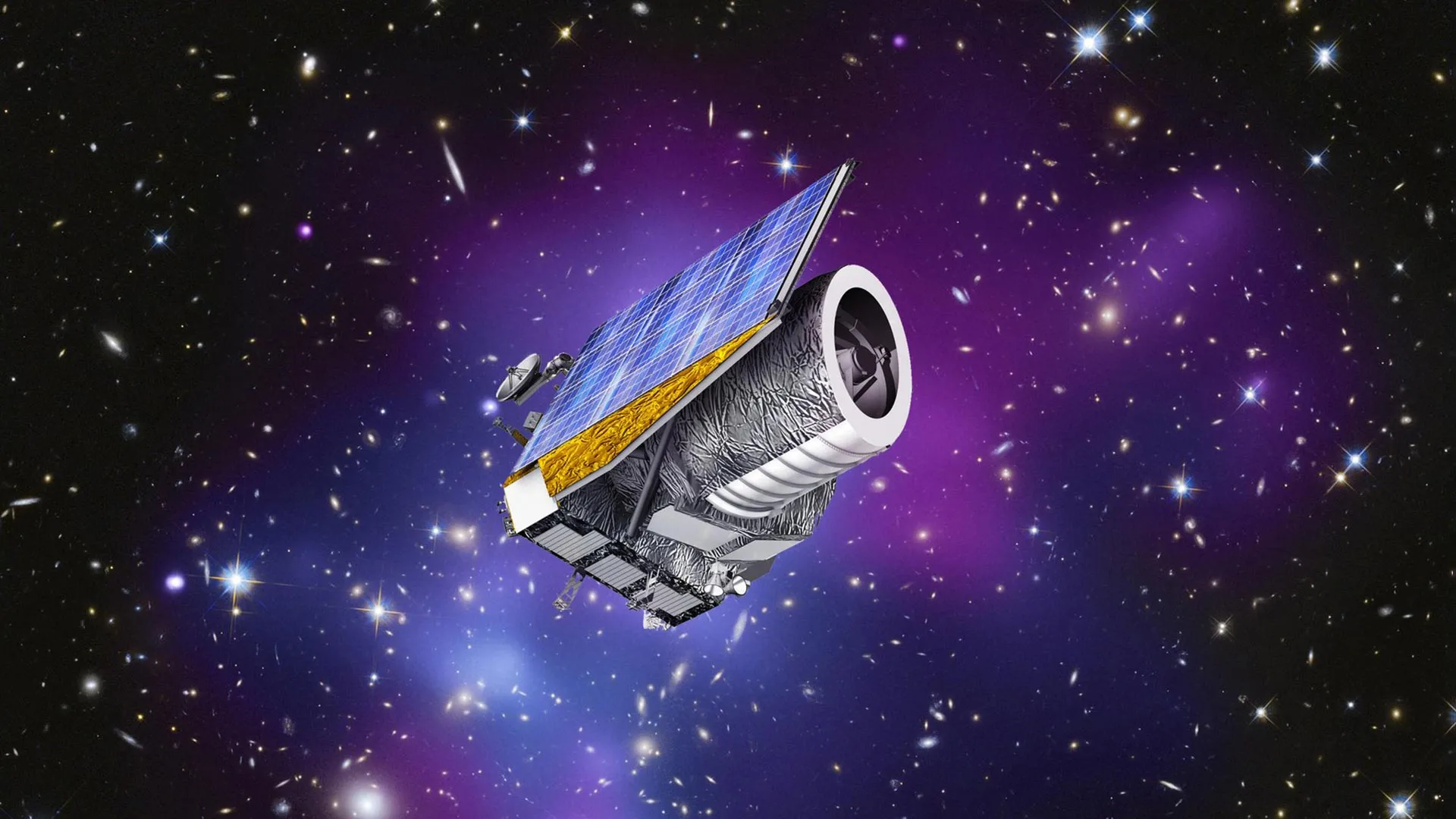
The European Space Agency’s (ESA) Euclid space telescope has discovered something unexpected in our solar system. The images, taken between September 16 and 24, 2026, reveal a previously unknown comet, the first discovered by the mission.
The achievement is all the more remarkable given that Euclid was designed to take detailed pictures of distant galaxies rather than track fast-moving objects like comets. The speed with which the researchers identified and confirmed the discovery shows that Euclid is able to see new comets when they are far from the Sun. This capability may eventually help identify targets on ESA’s upcoming Comet Interceptor mission.
Mysterious Sequence Reveals Comet
Mikko Pöntinen, a PhD student at the University of Helsinki, found this out with the Solar System Objects Science Working Group of the Euclid Consortium. Pöntinen developed special software to detect and track small objects in the solar system from telescope images.
“I was pleased to see my software flag a smeared ‘streak’ on several images — the result of a fast-moving object. By predicting its location I was able to pinpoint its location in other images, finding it completely in five sets of images. Further examination revealed that it had a dark cloud around it, indicating an active comet spewing dust and gas.”
The object appeared in an area of the sky known as the ‘Euclid Deep Field North’. Over several days, the telescope photographed it in five different fields of view, taking two and four exposures for each field for a total of 16 exposures.
After searching the catalog of known asteroids and comets without finding a match, Pöntinen submitted the observation to the International Astronomical Union’s Minor Planet Center (MPC) as a possible new star. The report enabled astronomers using telescopes on Earth to make further observations. On October 8, the MPC officially confirmed the discovery. The comet is designated C/2026 S1 (Euclid).
A Comet in a Strange Orbit
The newly discovered comet is 1.3 billion kilometers (about 800 million miles) from Earth. That distance is comparable to the distance from the Sun to a point between the orbits of Jupiter and Saturn.
However, comets travel well outside the flat plane where the planets orbit the Sun. It is currently positioned almost directly above the Sun, following a sweeping path across the solar system that will take thousands of years to complete.
The International Astronomical Union’s Minor Planet Center (MPC) serves as the international center for the observation of asteroids and comets. It collects data from observers around the world to confirm findings, determine orbital paths, and assign official names. As more observations become available, astronomers will be able to calculate the orbital period of C/2026 S1 (Euclid) more precisely.
Why Euclid Rarely Found New Commodities
Although Euclid had seen comets before, they had all been discovered. Several aspects of telescope design and observation techniques make finding previously unknown objects in our solar system very difficult.
Euclid deliberately avoids the area of the sky around the plane of the solar system, where large numbers of asteroids and comets can be found. The dust in this area produces unwanted light that can interfere with sensitive telescope observations of the distant universe.
The spacecraft also follows a ‘step and gaze’ observation strategy, typically imaging each part of the sky only once. This means that researchers cannot easily point Euclid at a newly discovered comet to gather more information about it.
Identifying the objects in our solar system is an important part of Euclid’s scientific work. Researchers must account for everything from its images so that irrelevant features, including comet trails and unwanted light, can be removed without compromising the accuracy of its galaxy measurements.
“There are very few comets expected to be discovered by Euclid so it was exciting that the combination of the comet’s cycle and Euclid’s scans in those days captured this object in multiple images,” said Bruno Altieri, Euclid Archive Scientist, and part of the archaeological team.
Preparing for Future Comet Encounters
Euclid’s unexpected discovery also provides valuable information for scientists working on ESA’s future Comet Interceptor missions. Although the newly identified comet is not an ideal location for the spacecraft, the successful detection and rapid notification process shows how the two missions can work together to identify potential targets.
“Although this particular comet is not a suitable candidate for the Comet Interceptor, the process of discovery and warning gives us a real test case of how our two groups of missions will coordinate in the future. And we are certainly happy to have found a previously unknown comet for the Solar System community to track,” added Valeria Pettorino, Euclid Project Scientist.
Ancient Fossils of the Solar System
Comets are ancient bodies formed from ice and dust left over from the formation of our solar system about 4.6 billion years ago. Most come from the Kuiper Belt and Oort Cloud, regions found beyond the orbits of the outer planets (interstellar comets from other solar systems).
As a comet approaches the Sun, the rising temperatures cause its ice to turn into gas. The escaping gas and dust form a glowing, faint cloud known as a ‘coma,’ and an extended tail.
Because the comets native to our solar system have remained unchanged since their formation, they preserve valuable evidence of the material and environmental conditions that existed when the planets first formed. Studying these ancient objects may also help scientists understand the origins of Earth’s water and the chemical elements that form life.
Euclid’s Hunt for Dark Matter and Dark Energy
The main goal of the Euclid mission is to reveal how dark matter and dark energy influence the physical universe. During its six-year mission, the space telescope will study the formation and motion of billions of galaxies at distances of up to 10 billion light-years.
The discovery of the comet was reported on behalf of the Solar System Objects Science Working Group of the Euclid Consortium by M. Pöntinen, AA Nucita, A. Franco, M. Granvik, B. Altieri, S. Kruk, BY Irureta-Goyena and B. Carry.
Source link