Yvonne Capehart Weah’s family used to get together in the township where she grew up in Liberia. At the beginning of November every year, they gather to celebrate the Liberian version of Thanksgiving.
Eddie Raynes
hide captions
Eddie Raynes
Yvonne Capehart Weah is from Liberia, a country in West Africa, and is one of her twelve children.
“I’m second to last – I’m eleventh,” he says. “We have big families in Liberia.”
Every year on the first Thursday in November, Weah’s family gathers in Caldwell, the township where he grew up, to celebrate Liberia’s Thanksgiving.
“When we meet, the team is divided [so] so big that you can’t sit around the dining table,” he explained. “So we do it outside under a tree. And when we meet, it’s like having a party.”
The Liberian holiday dates back to the first half of the 19th century when the American Colonization Society established a community that would expand into the country. It was founded by black Americans – both those born free and enslaved who had been freed – whose movement was sometimes voluntary, sometimes forced. “Settlers from America brought the tradition of Thanksgiving to Liberia,” Weah said. Once it was replanted, the holiday evolved over time due to national events.
Liberia gained independence in 1847 but the British continued to try to take over more territory. In 1883, President Alfred Francis Russell, an Episcopalian priest, asked God to help stop the slaughter.
That appeal was “a prayer to protect the invaders, to prevent them from entering our territory,” said Weah.
The people of Liberia managed to preserve their sovereignty. And that year, the legislature officially established Thanksgiving as a national holiday focused on religious thanksgiving at the time.
It is a holy day for all
Weah sums up Liberia’s Thanksgiving this way: “It is to thank God for our freedom, divine protection. It gives thanks to God for unity and harvest.”
Weah says his family’s celebration, like many others in Liberia, begins early in the morning at church. But this holiday is for people of all religions, and other religious communities also mark the event
“Muslims, they go to mosques and pray,” he said Sekou Muhammad Sheriffa YouTuber visiting his home country of Liberia to showcase its offerings and cultural heritage, including Thanksgiving. “And Muslims, Christians, and others – everyone celebrates this day as a holiday.”
When the Sheriff was a boy, this was the day he counted down to get a new outfit.
“What my father used to do for me,” said Sheriff, was to buy “a shirt suit, and then buy me a slip.” His favorite suit was not white.
Over the years at Thanksgiving, he has become accustomed to eating a variety of stews, including ones made from sweet potato leaves and snails gathered from the field.
“We call it king meat,” the Sheriff said with a laugh. “Very good, very good.”
Afternoon meals vary from house to house in Liberia.

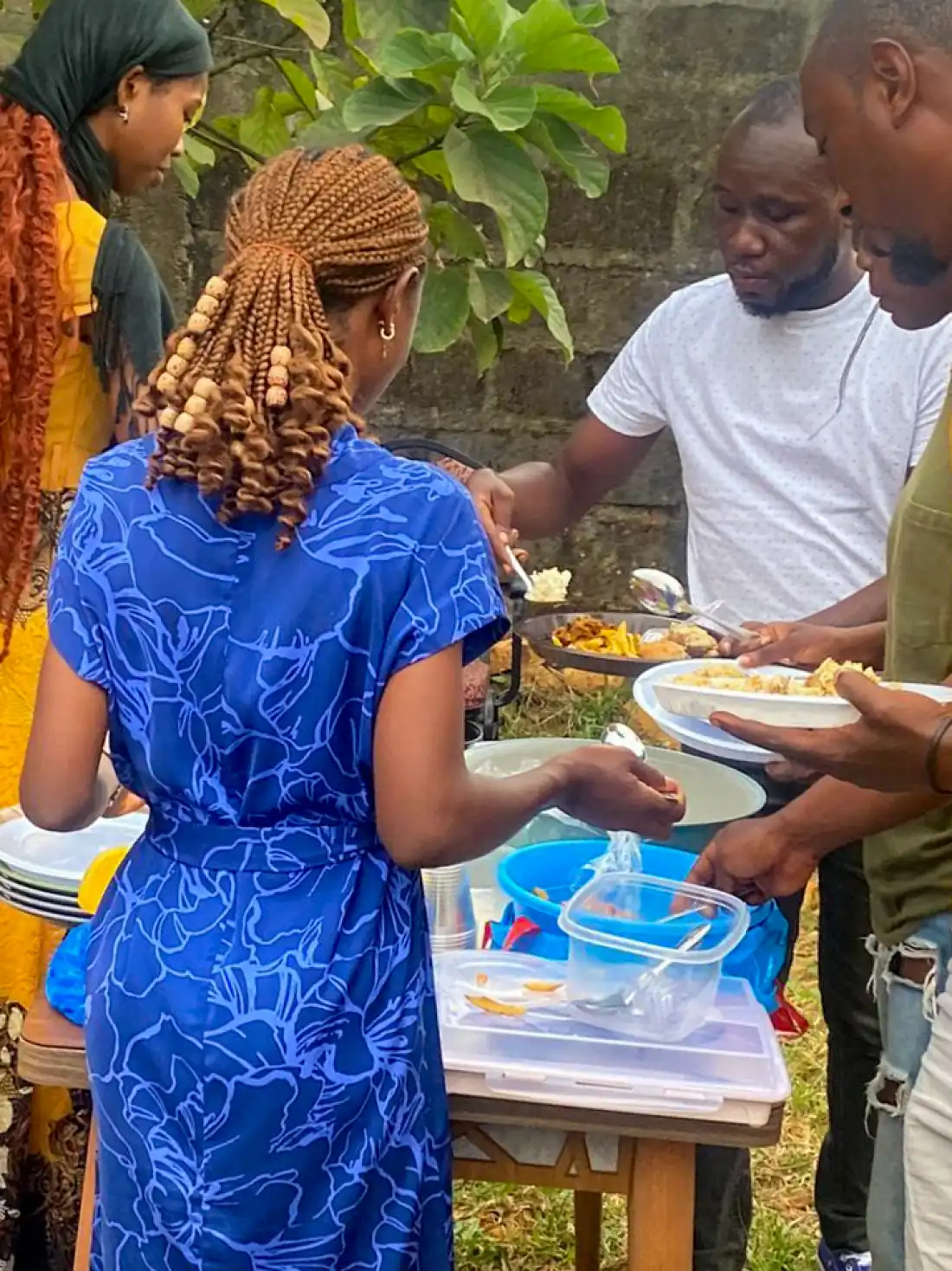
Yvonne Capehart Weah’s nieces and nephews fill their plates at a family gathering in Caldwell.
Rebecca Blapoh Weah
hide captions
Rebecca Blapoh Weah
“We don’t do turkey,” Weah said, “but we do chicken. We do fried chicken, smoked chicken, roasted chicken.”
Weah’s family also serves jollof rice, watermelon, pineapple and a variety of stews, including fufu and soup. It is a mixture of cassava, fish, chicken, okra, chili peppers and more. “That makes the soup more delicious,” Weah said. “It should be like that [at] every Thanksgiving.”
(Weah is not particularly fond of cooking. However, if you say to me, ‘Go to the kitchen and cook or sit in the living room and study,’ he says, “I will sit in the living room and study.”)
“Thank you God”
This year, the Sheriff did not have the resources to host Thanksgiving. But he says he always thanks God for keeping him healthy and for keeping Liberia peaceful after the civil conflicts that ravaged his country from 1989 to 1997 and 1999 to 2003.
Weah is also grateful. He says: “When I go to Thanksgiving, I thank God for where I came from, where I am now, and I also thank God for where he will take me because I know that he is in charge of the future.”
Weah is the host of the show The We-Care Foundationa non-profit educational organization that, among other things, teaches children to read and write. “A child who learns will become an adult who learns,” he said.
“And we expect informed adults to make informed decisions that affect both their social and economic lives” — in ways, perhaps, that they will be grateful for one day.
For stories about life in our changing world, sign up for the NPR Global Health newsletter.
Source link