New research suggests that the Milky Way produces stars in an unexpected place, revealing a striking contrast between our galaxy and most of its neighbors. The findings also raise questions about the general nature of the Milky Way, suggesting that part of what astronomers have long considered a spiral arm may actually be something else.
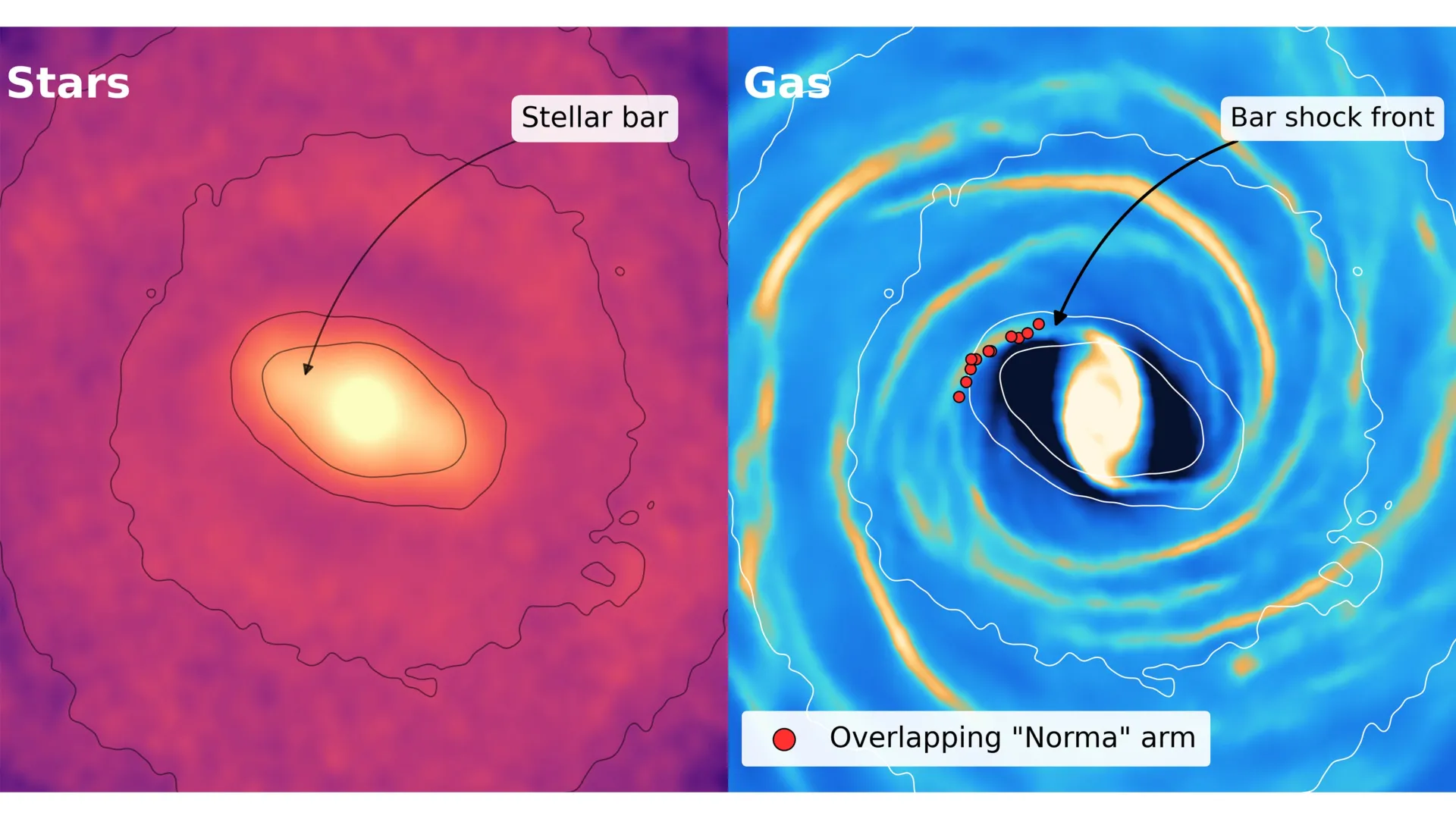
The discovery comes from research led by a University of Sydney PhD student, who found evidence that a large rotating star structure near the center of the galaxy is generating powerful shock waves through the surrounding gas clouds. These waves squeeze the gas together, creating conditions that allow new stars to form in an environment where such high energies prevent their birth.
Published on Nature Astronomythis study also questions the nature of the orbiting arm of Norma, the Milky Way feature named after the constellation Norma as seen from Earth.
Lead author Dr. Hillary Davis, who recently completed her PhD at the University of Sydney’s School of Physics and the Sydney Institute for Astronomy, said the research provides new information about the structures near the galactic center and how gas flows around them.
“At its heart, star formation is a process we understand from everyday physics. Energy sets matter in motion. In this case the gas is compressed, and that pressure can create the conditions for new stars to be born on a large scale,” said Dr. Davis.
“In many similar galaxies, star formation tends to occur near spiral arms. What’s surprising is seeing this happen in a different part of our Galaxy, where shocks are often so strong that star formation is often suppressed.”
A Hidden Star Factory in the Heart of the Milky Way
The Milky Way belongs to a class of galaxies known as barred spiral galaxies. Unlike galaxies that only have many stars and spiral arms around them, these systems consist of long formations of stars from their central location. In our galaxy, this structure is called the Galactic bar.
As the bar rotates, its gravity influences the nearby gas, driving it into strong shocks. These two waves compress gas in the same way that a heat wave compresses air.
Studying this structure on Earth is more difficult because it is located inside the Milky Way rather than looking at it from outside. A lot of cosmic dust also blocks our view of the galactic center.
“The Galactic Bar is not easily seen due to a combination of our position in the Galaxy and the dust obscuring our view,” said Dr. Davis.
“Because of this, the bar structures are very controversial.”
Observations of other barred galaxies have shown that these shocks often prevent the formation of new stars, even in gas-rich regions. The intense conditions make it difficult for gas to collapse into stars.
However, new findings show that the Milky Way may behave differently. Although not the only known example, our galaxy appears to belong to a small group where star formation occurs near central bar shocks.
“We believe that the bar of the Milky Way has star formation occurring around it and shocks, which is unusual for many lines in nearby galaxies,” said Dr. Davis.
The Milky Way Spiral Arm May Not Be What It Seems
To investigate this unusual activity, the research team compared detailed computer simulations that show how galaxies change over billions of years with observations of the regions where massive stars form.
An important part of the evidence came from masers, naturally occurring sources that emit highly focused microwave radiation. This emission is associated with the formation of massive stars and works on the same principle as lasers, but at microwave wavelengths.
By examining the shapes of these masers, the researchers found a striking match between the actual observations and the shock locations predicted by their simulations.
“We found that the masers previously associated with the Norma arm closely match the shocks predicted by our simulations,” said Dr. Davis. “This suggests that at least part of the so-called Norma arm may not be a spiral arm, but a star-forming region at the leading edge of the Galactic bar.
“This raises questions about the composition of the rotating Galaxy, and the Milky Way region, which require further investigation,” he said.
The possibility is important because it suggests that some of the star formation associated with Norma’s spiral arm may have occurred near the central bar. If confirmed, this explanation could change the way astronomers understand the arrangement of stars and gas in that part of the Milky Way.
New Evidence Could Redraw the Map of the Milky Way
Besides revealing the unusual place of star birth, the study also sheds light on the physical properties of the Galactic bar itself.
Astronomers have debated the length, shape, and speed of the structure’s rotation for decades, because the Milky Way’s dust and our field of view make precise measurements challenging.
“Our findings put some constraints on the size, angle and rotation speed of this central bar,” said Dr. Davis.
The team’s analysis shows that the bar extends about 4.3 kiloparsecs, the equivalent of about 14,000 light-years, outward from the galactic center along its long axis. This supports an image of the Milky Way that consists of a long, slowly rotating bar.
The results show how advanced simulations can help scientists probe regions of our galaxy that are difficult to see directly. By comparing models spanning billions of years with available astronomical evidence, researchers can narrow down the possible formations and processes that shape the Milky Way.
“By comparing a new generation of computer simulations of a large galaxy, evolving over billions of years, against a limited set of observations, we now have a powerful understanding of the processes of bar and star formation in the Milky Way,” said Dr. Davis.
The authors reported no competing interests. Research funding came from the Australian Research Council, the Knut and Alice Wallenberg Foundation, the Swedish Research Council, the Swedish National Space Agency, the LMK Foundation and eSSENCE (Sweden).
Computing and data storage facilities were provided by National Computing Infrastructure Australia, an NCRIS capacity supported by the Australian Government, and LUNARC, the Center for Scientific and Technical Computing at Lund University, Sweden.
Source link