In 1602, a rare manuscript of the Qur’an was in the library of Emperor Akbar; after passing through the hands of Mughal royalty and diplomats, it was sold in London for £863,600, 14 times the estimate

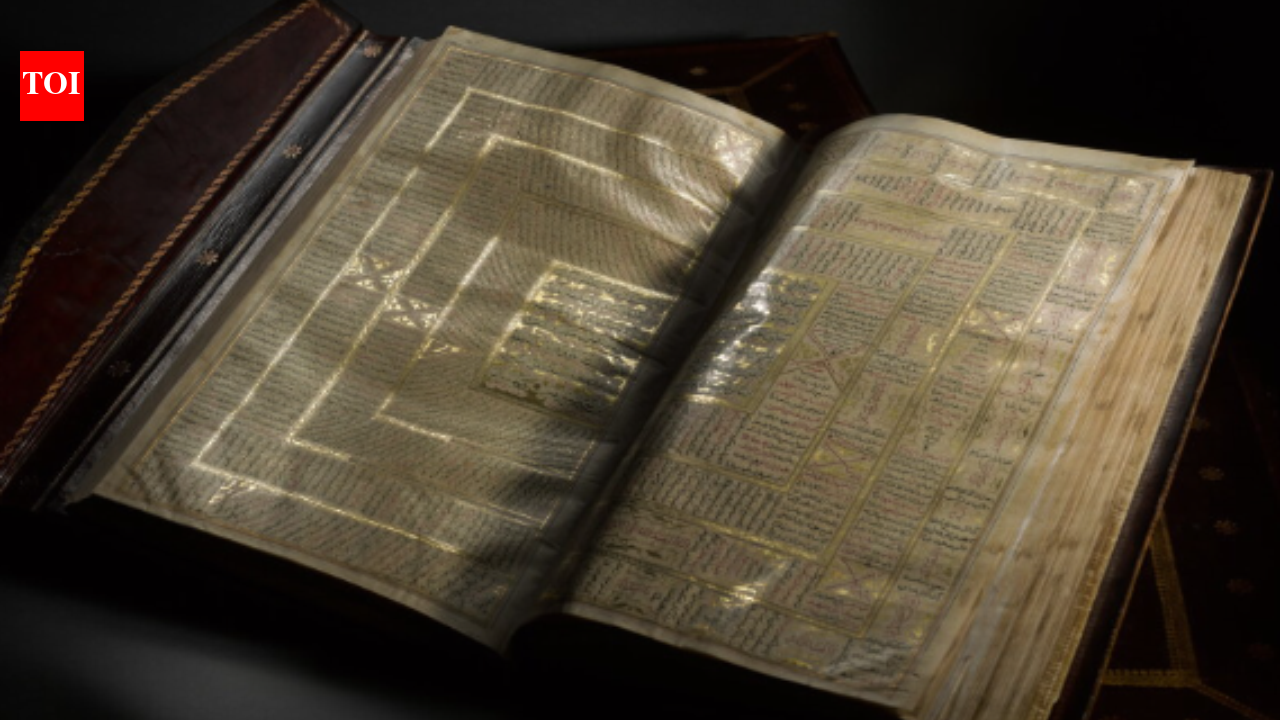
A rare Qur’an manuscript linked to the library of Mughal emperor Akbar fetched £863,600 at a Sotheby’s auction in London, selling for more than 14 times its highest estimate after a 15-minute bidding war.
Dating from the late 16th century, this exquisitely decorated manuscript bears traces of its passage through the Mughal royal collection, including library stamps and checkmarks that provide glimpses into its history.The four-volume work was offered as the starting point for Sotheby’s Arts of the Islamic World and India sale on October 29, 2025. According to Sotheby’s post-sale report, it was estimated at £40,000-£60,000, but the final price of £863,600, including the buyer’s premium, far exceeded the buyer’s expectations.
The result was among the highlights of an auction that brought together important works of Islamic and Indian art.What makes a manuscript particularly important is not just its age or the richness of its decoration. It includes the text of the Qur’an and eight commentaries, including many years of study in Arabic and Persian. Its Mughal library marks survive and provide tangible evidence of its association with the royal collection.
A manuscript attached to Akbar’s library
Sotheby’s catalog identifies the inscription as belonging to Akbar (1542-1605), the Mughal emperor who ruled from 1556 until his death. Its appearance dates back to 1602, when he established a link to the state library during his reign.The manuscript later remained in the royal collection until the reign of Muhammad Shah (1702-1748), with a catalog covering this phase of its history from about 1717-1727.
It then became the Middle East embassy in the United Kingdom in the early 1970s.The last pages of this manuscript contain some of the most revealing evidence of its past. The fourth volume contains the emblems associated with the Mughal librarians, as well as the inscriptions of the examination of the work. Some of these signs are dirty or only partially legible, but the surviving details help researchers trace their history through successive reigns.One of the most important signs is that of Muhammad Yusuf, a librarian active in the late reign of Akbar and the early reign of his successor, Jahangir. The impression bears a date corresponding to Akbar’s 46th regnal year. This page also bears a genealogical symbol associated with Shah Jahan, while an inscription above one of the test notes refers to Emperor Alamgir, better known as Aurangzeb.Some signs are associated with the time of Muhammad Shah.
Together, these marks suggest that the manuscript was studied and preserved within the Mughal library tradition for generations, rather than simply being associated with the empire through later transmission.
Four volumes, eight commentaries and elaborate decorations
The manuscript is titled al-Itqan of Ilm al-Qur’antranslated by Suthu as “The Perfection of Qur’anic Science”. It was composed as one large tome, consisting of eight books of Qur’an exegesis, or tafsir – Explanations of scholars and interpretations of the Qur’an.The descriptions span nearly five centuries of study, up to and including the reign of Akbar. It includes the works of influential scholars such as al-Qushayri, al-Baghawi, al-Zamakhshari, al-Baydawi and two allied scholars Tafsir al-Jalalayn. The collection also includes Tafsir-i Husayni as well as Tafsir-i Muhammad.The physical handwriting is equally impressive. Written on paper sprinkled with gold, it consists of four volumes containing hundreds of leaves. The text of the Qur’an appears in bold black etc script, accompanied by a red Persian interlinear version nasta’liq text.The verses are separated by golden circles with red and blue dots. Surah titles appear in white text against a gold background, set within richly colored decorative panels. Gold, red, blue and black rules frame the text, while the margins feature vegetal motifs made of gold.The analysis took four edges around the central text of the Qur’an, with key words and phrases highlighted in red. The opening pages feature illuminated designs, including gold medallion-like decorations known as the shamsas. Each volume is covered in brown leather binding with stamped decoration.The size of this masterpiece is great: Sotheby notes that this manuscript contains a thousand leaves sprinkled with gold, richly decorated with pointed flowers.
It’s the odd comment that sets you apart
Among the eight comments, one stands out for its unusualness: i Tafsir-i Muhammadwritten by the Gujarati Chishti Sufi scholar Shaykh Hasan Muhammad ibn Shaykh Ahmad Miyanji Chishti, who died in 1575.According to the Suthu catalogue, this analysis is not known to survive in other manuscript copies.
Its presence alongside seven widely known works makes the collection unusual.Hasan Muhammad Chishti spent most of his career under the patronage of the rulers of Gujarat before Akbar took over the province in 1573. He is also associated with the Hasan Muhammad Chishti Mosque in Ahmedabad, which was built in 1565-66.Sotheby’s suggests that the contents of the manuscript may provide clues to the circumstances of its creation.
Akbar’s interest in Chishti Sufism is well documented, and the inclusion of this rare commentary suggests that the manuscript was likely produced in the royal scriptorium – the workshop where manuscripts were copied and prepared for the court – either during the scholar’s lifetime or shortly thereafter.Evidence of dating is especially important. Akbar’s scribe’s seal indicates that the manuscript was in existence in 1602, only 27 years after Hasan Muhammad Chishti’s death.
The catalog presents the possibility of a state connection as a hypothesis, rather than a verified account of where the manuscript was produced.
Outstanding result
The sale of the Qur’an was part of Sotheby’s Arts of the Islamic World and India auction, which realized a total of £10,088,793 against a pre-sale estimate of £4.4 million to £6.6 million. According to the post-sale report, slightly more than half of the lots sold at prices above their maximum estimates, with bidders participating from 25 countries.A Qur’an was among the sale’s highlights, alongside items such as a pair of silver-mounted guns made for Tipu Sultan, which sold for around £1.1 million against an estimate of £60,000-£80,000.Yet the value of a manuscript goes beyond its price at auction. Its pages preserve a combination of religious studies, Persian translations, sophisticated calligraphy and evidence of royal identity.
Stamps and test notes are very important because they connect a living organism to the people and institutions that owned it.More than four hundred years after it entered Akbar’s library, the manuscript has once again attracted attention – this time in an international auction room, where its unusually rich content and Mughal history have helped make it one of the best sellers.