Psychology says that people who are told to keep smiling all day, like waiters and shop assistants, may end up unhappy and irritable, because a single smile raises mood but repeated forced smiles erase the benefit |

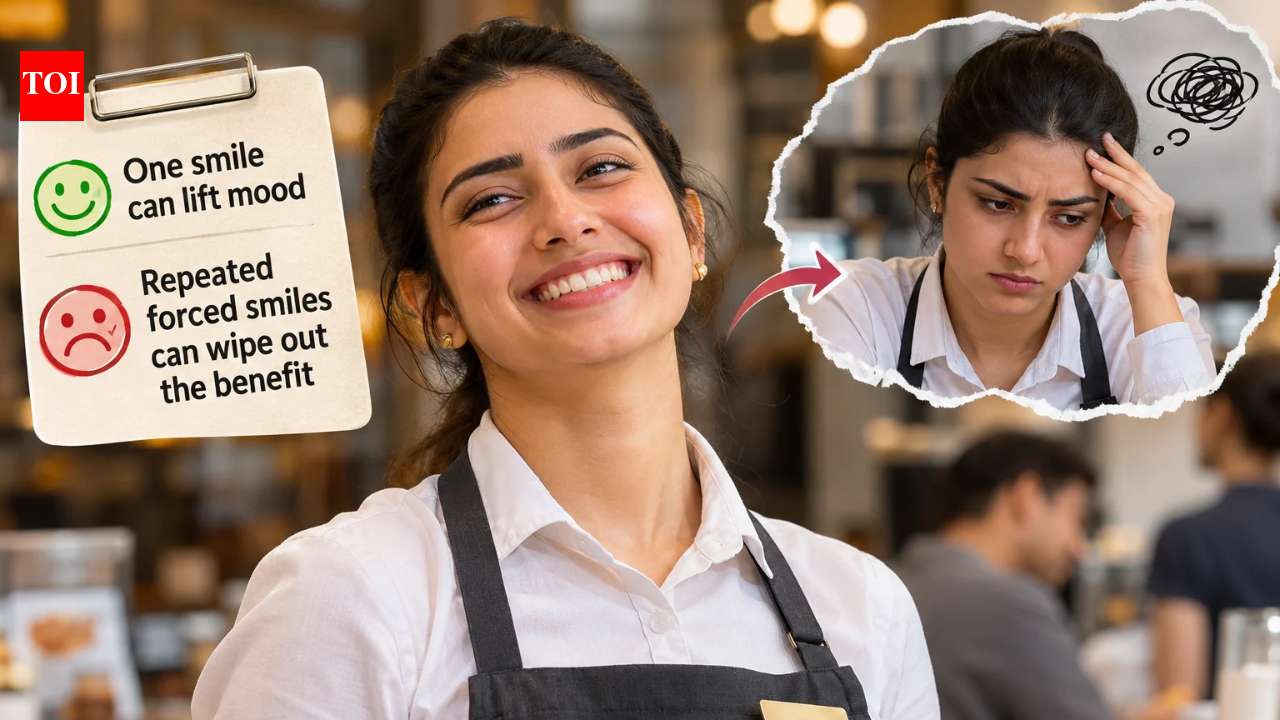
Smiling is often considered one of the easiest ways to improve a person’s mood, but expecting to do it over and over again can have the opposite effect. People who work in customer-facing jobs, such as waiters, shop assistants and receptionists, are often expected to show happiness regardless of how they feel. However, new research suggests that repeatedly forcing yourself to smile, especially when accompanied by external pressure, can reduce its mood-enhancing benefits and increase negative emotions. A study involving 1,174 participants found that while smiling once may provide a lower level of happiness under certain conditions, repeating the exercise weakens the effect. In some cases, participants reported lower happiness, as well as increased irritability and anger.
Psychology Research explores why forced smiles can leave people unhappy
The study, titled Is smiling your way to happiness or sadness? An experimental test of the competing theories, was conducted by psychologists Nicholas A. Coles, Annabel V. Dang and Joao Francisco Goes Braga Takayanagi of the University of Florida.Published online October 1, 2026, in the Journal of Experimental Social Psychology, this study investigated why previous research has produced seemingly conflicting findings about the relationship between smiling and happiness. Although some research has suggested that intentionally smiling can improve mood, studies examining emotional demands in workplaces have repeatedly linked pretending to be happy with poorer emotional well-being.The researchers examined whether three factors could help explain these differences: the emotional context when someone smiles, how often they need to smile, and whether they face external pressure to maintain the expression.Their findings suggest that smiling can improve happiness in certain situations, but the benefit depends on the circumstances. Repetition and the threat of financial penalties can weaken or eliminate a positive outcome.
How did the researchers conduct the study?
The researchers initially recruited 1,201 people for an online survey, with 1,174 participants included in the final analysis. Participants were shown images intended to evoke different emotional responses.Some pictures had happy subjects, including cats and flowers, while others depicted unpleasant situations, such as theft and animal abuse.Participants were instructed to intentionally express a smile or let their facial expression develop naturally. Depending on the group they were in, they did their task once or repeated it 10 times.The researchers also introduced the factor of financial pressure. Half of the participants were told they could lose $2 of their $6 payment if they failed to follow instructions to smile. However, this was only a threatened penalty. All participants eventually received their full payment.After completing the tests, participants reported how happy they were. This allowed the researchers to examine whether smile frequency, emotional context and the likelihood of financial punishment influenced their reported happiness.
A single smile can improve mood, but repeating it changes the effect
The findings showed that a single intentionally produced smile could provide a modest improvement in happiness when participants viewed unpleasant pictures. This effect was seen even among those who were warned that they might lose money.However, the benefit weakened when participants were instructed to repeat the smiling task. When repeated smiling was combined with the threat of financial punishment, its mood-enhancing effect was nearly eliminated.The results were different when participants viewed happy pictures. Making one smile gives you a little extra boost in happiness compared to letting their facial expression grow naturally.However, repeatedly forcing a smile or doing so under financial pressure resulted in lower self-reported happiness than allowing participants to respond naturally. Further analysis also found that forced smiling in these pleasant picture conditions was associated with greater irritability and anger.The findings suggest that facial expressions that may briefly enhance a person’s mood when produced voluntarily or occasionally do not have the same effect when they become a repeated obligation.
Why does a forced smile make people unhappy?
The findings are related to a psychological concept known as emotional labor, which describes the effort people make to control their emotions and their external expressions in order to meet the expectations of their jobs.Customer-facing employees are often faced with situations where they are expected to appear friendly and enthusiastic, even when they are tired, frustrated or dealing with difficult customers.For example, a waiter may be required to smile when serving an unhappy customer, while a shop assistant may be expected to show cheerfulness over a long period of time. Similarly, receptionists and customer service staff may need to feel welcome regardless of their attitude.Psychologists often distinguish between two types of emotions.Making a face involves changing the way a person speaks without changing the feelings a person is actually feeling. Smiling when you are frustrated or pretending to be happy when you are tired are examples of this behavior.On the other hand, acting deeply involves trying to change one’s inner feelings so that what one says is real. An employee may, for example, focus on the positive aspects of helping a customer rather than simply smiling at them.A new study suggests that repeatedly producing an utterance under external pressure may carry an emotional cost. However, it did not directly measure the long-term effects of out-of-staffing.
What is the face response hypothesis?
The findings also add an important dimension to the facial response hypothesis, a psychological theory that suggests that facial expressions can influence emotional experiences.According to this theory, facial muscle movements associated with certain emotions can influence how people feel. This provides a possible explanation for why smiling on purpose can sometimes make a person feel happier, even when they initially feel positive.A large international study published in Nature Human Behavior in 2022 tested this idea by the Many Smiles Collaboration. It involved 3,878 participants in 19 countries and found that voluntarily producing facial movements associated with smiling can increase or trigger feelings of happiness.However, the findings were less clear for an indirect procedure that involved holding a pen between the teeth.The 2026 study adds another dimension to this discussion. It suggests that the potential emotional benefits of smiling depend not only on facial movements but also on how often people express them and whether they feel compelled to do so.
What does this mean for people working in customer-facing jobs?
The research raises questions about the workplace expectations that require workers to maintain a happy appearance during their shifts.While businesses often encourage employees to smile to create a welcoming atmosphere, findings suggest that making smiling mandatory can have unintended consequences.The lead researcher for this study, Nicholas Coles, also used his experience working in customer service. He remembers being reprimanded in a park in Florida for not smiling at work. That experience helped fuel his interest in understanding why research suggesting that smiling improves happiness did not always match people’s experiences in customer-facing jobs.Coles suggested that workplace policies requiring employees to smile could reduce their emotional independence. Such expectations may also affect customers, who may feel obligated to respond positively to friendliness displayed under pressure.However, the study did not track workers directly during their working hours or reveal whether waiters, shop assistants and other customer-facing workers are less happy with their jobs. Instead, it recreated some aspects of workplace stress in the online environment.The researchers’ findings therefore highlight the difference between smiling because someone wants to and smiling because they are often expected to do so.The broad takeaway is that trying to generate happiness doesn’t always produce the intended result. Smiling may provide a temporary emotional boost, but when it becomes a repeated bond, the experience may become a source of frustration instead of joy.
Source link