Scientists find unusual carbon signature in Hawaiian volcanic rocks that could reveal 4.5-billion-year-old secret about Earth’s core |

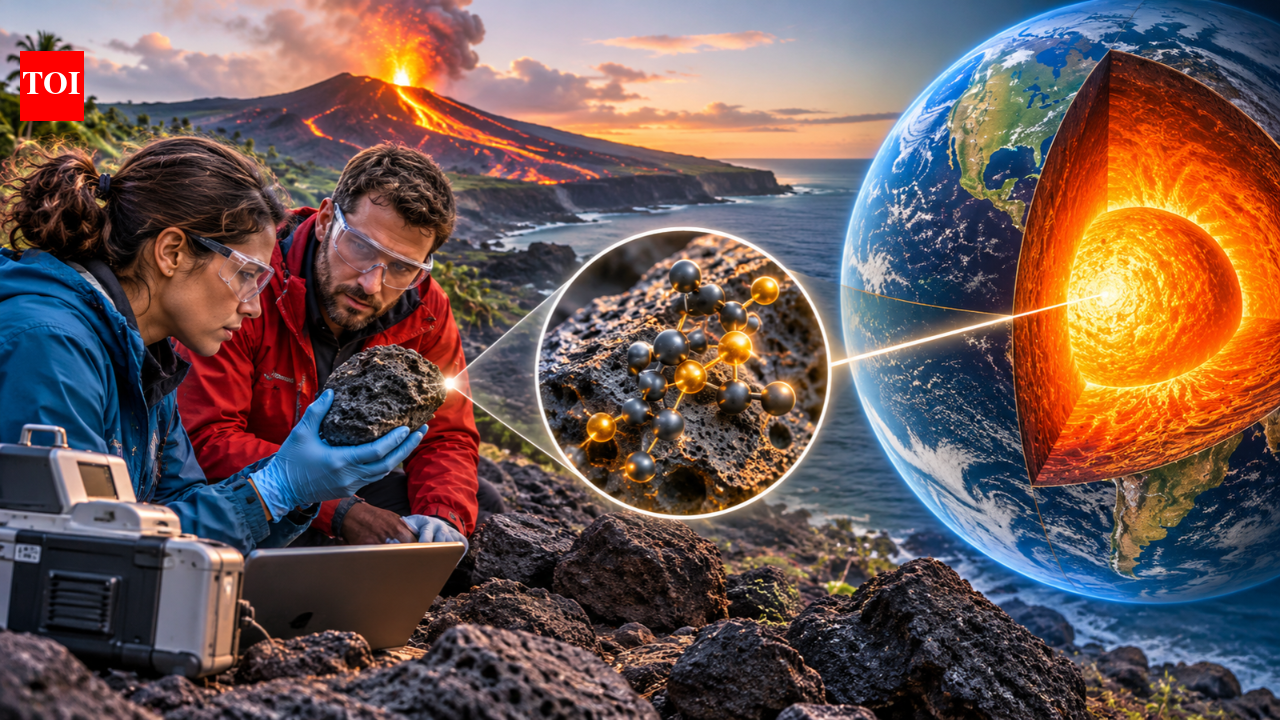
Scientists may have uncovered a 4.5-billion-year-old secret hidden deep within the Earth after finding a rare carbon signature in volcanic rocks from Hawaii. The findings suggest that carbon has been leaking from the planet’s core into the surrounding mantle, giving a rare glimpse into Earth’s inaccessible region. The researchers analyzed small pockets of molten rock trapped inside the volcanic crystals and found a chemical signature not unlike that usually associated with volcanic eruptions. According to a study published in the journal Proceedings of the National Academy of Sciences, titled ‘Isotopically heavy carbon in the core’, this could also help explain where the Earth’s carbon came from, pointing to carbon-rich meteorites from the outer reaches of the Solar System.
Hawaiian mud reveals unusual signature of carbon-13
An international team of researchers analyzed the carbon isotopes in the melt composition from the lava of a Hawaiian volcano. These small pockets of molten material become trapped within the growing crystals before the magma reaches the surface. Because the samples were preserved before major gas losses, they allowed researchers to investigate carbon signatures that may have been altered during volcanic activity.Very accurate measurements of carbon-13, the heaviest naturally occurring form of carbon. The researchers found that melt deposits from shield stage lavas had a carbon isotope signature of -1 ± 2 per mille (‰). This is in stark contrast to the -7 ± 2‰ signature recorded in the recrystallized stage lavas, which show typical mantle composition.
An unusual carbon signature points to an Earth-mantle core boundary
Researchers have linked an unusual carbon signature in shield stage lavas to the deep mantle plume of Hawaii. These lavas are interpreted as a sample of material from the central axis of the plume, which is thought to originate near the core-mantle boundary, the region that separates the Earth’s iron core from its rocky mantle.In contrast, the renewed stage lavas are interpreted to be from mantle material drawn from the outer parts of the plank. Their carbon isotope measurements were consistent with the general signature of the mantle. The difference between the two groups of volcanic samples led the researchers to suggest that the material rich in carbon-13 is unusually carbon-rich in the Earth’s core. In the paper’s key statement, the authors explain: “We interpret this as a carbon fingerprint that is transferred from the core to the fabric.“This interpretation suggests that carbon is exchanged between the deep interior of the planet and the surrounding mantle, which may provide a way to investigate the composition of the reservoir that remains unobservable directly.
Volcanic rocks provide new evidence of carbon exchange deep within the Earth
The discovery is very important because the Earth’s core is believed to contain most of the planet’s carbon. However, finding its exact composition has been difficult because scientists cannot directly collect samples from this extremely deep area.The researchers argue that carbon isotope measurements provide a constraint on a previously unknown carbon signature. The melt-stage inclusions point to a primary carbon isotope composition of -1 ± 2‰, which the team interprets as evidence of carbon exchange between the core and the mantle. The renewed stage samples, meanwhile, retain a very typical mantle signature of -7 ± 2‰.The research therefore provides a new way to investigate the distribution of carbon within the Earth. Rather than relying solely on surface rocks or indirect measurements of deep planetary reservoirs, scientists can use volcanic material brought up by plumes to test chemical signatures from deep within the planet.
Carbon-rich meteorites likely delivered Earth’s original carbon
Besides revealing a possible trade-off between Earth’s core and mantle, the findings also answer a long-standing question about the origin of the planet’s carbon. The researchers’ results point to carbonaceous chondrites, a type of meteorite rich in carbon-bearing material, as the main source of Earth’s carbon.These meteorites are associated with the outer Solar System. According to the study, carbon-rich material from these ancient planetary building blocks was brought to Earth during the final stages of its formation. Their isotopically heavy carbon signature is consistent with the composition taken from Hawaiian volcanic samples. The discovery provides a way to understand the origins of Earth’s evolution and provides a new constraint on the carbon composition of its core. Although the proposed transfer of carbon from the core into the mantle is explained by the isotopic evidence, the results provide a unique view of the chemical history of the Earth’s deep atmosphere.
Source link