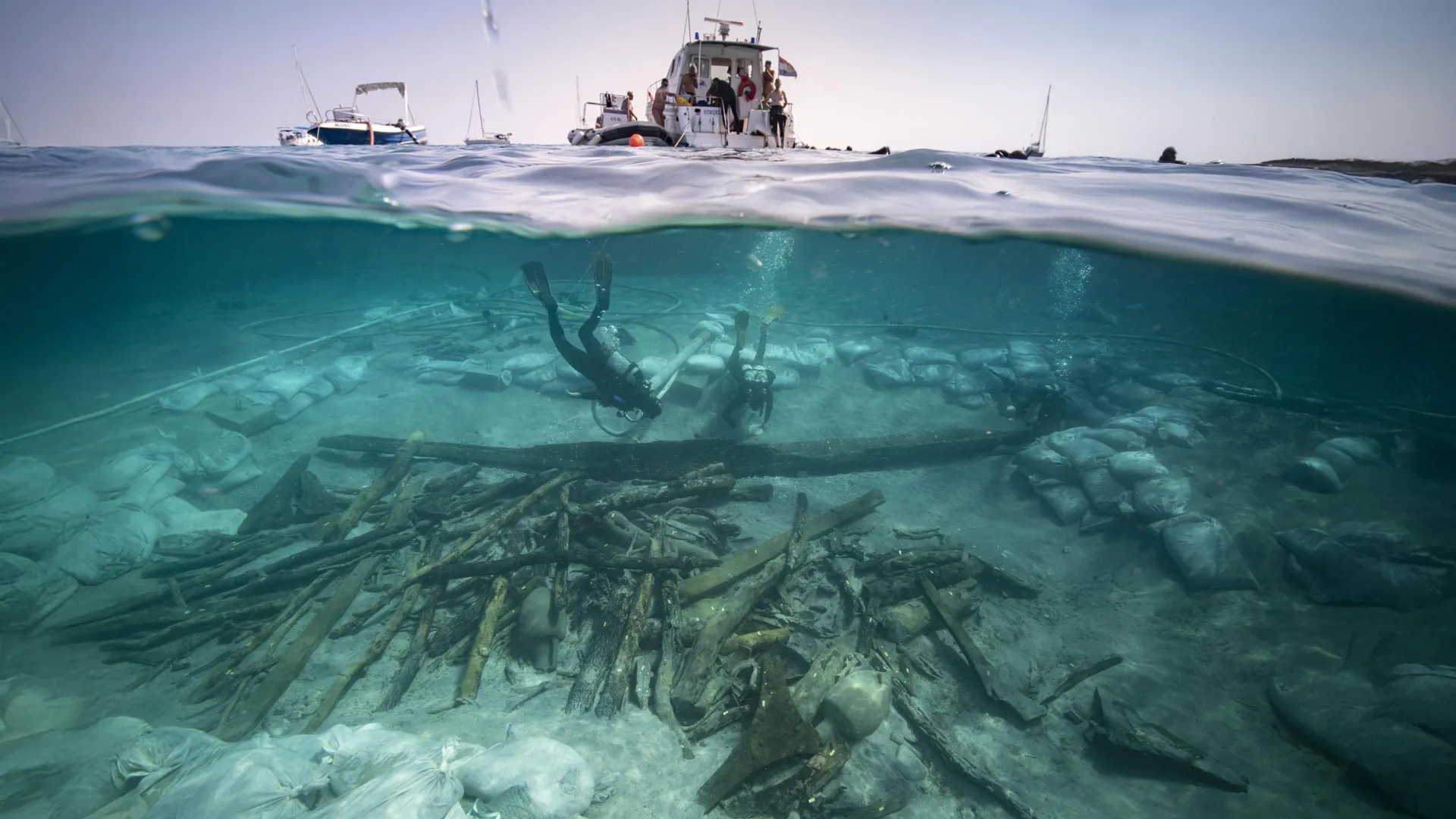
A 2,200-year-old Roman shipwreck off the coast of Croatia reveals how ancient shipbuilders protected their ships from the destructive forces of the sea. The researchers found two different waterproofing recipes, including one that combines pine tar and beeswax. Even more amazingly, tiny pollen grains preserved in sticky pores provide clues as to where the vessel was built and repaired during its life.
Since the dawn of time, shipbuilders have faced the challenge of keeping water out while protecting ships from saltwater, bacteria, and marine animals such as shipworms. Despite their name, shipworms are actually marine molluscs that burrow into wood and can cause significant structural damage.
But until the middle of the 20th century, archeological studies of ancient ships focused mainly on their wooden parts. The defenses that made these ships seaworthy were comparatively neglected, and waterproofing remains a relatively unknown aspect of ancient maritime technology.
In a new study published in Restrictions on ItemsFrench and Croatian researchers are investigating the armor of Ilovik-Paržine 1, a Roman Republic ship that sank about 2,200 years ago off the coast of present-day Croatia.
“In archaeology, little attention is paid to waterproofing organisms. However, they are important for navigation on seas or rivers and are true witnesses of the technology of past marine vessels,” said the first author, Dr. Armelle Charrié, archaeologist at the Laboratory of Mass Spectrometry of Interactions and Systems in Strasbourg. “When we studied these coatings, we found two different types on the ship: one made of pine tar, also called pitch, and the other a mixture of pine tar and beeswax. Pollen analysis on the coating made it possible to identify the plant taxa present in the vicinity during the construction or repair of the ship.”
Ancient Secrets of Waterproofing Revealed
Since its discovery in 2016, the shipwreck and its cargo have been the subject of several scientific investigations. However, this is the first study to combine molecular analysis with ancient pollen analysis to determine both the composition of the vessel’s waterproofing material and the plant species growing near where those pores were produced or deposited.
The research brought together experts from the Department of Underwater Archeology of the Croatian Conservation Institute and the ‘ADRIBOATS’ program of the Center Camille Jullian at Aix-Marseille University in France.
“Certain regions throughout the Adriatic have certain characteristics that have led local people to develop a particular style of shipbuilding,” Charrié said. “Only studies like ours that provide a glimpse into these cultures demonstrate true awareness and diversity.”
To find ancient recipes for waterproofing, researchers examined the body composition, molecular structure, and pollen content of the clothing. Among the methods they used was mass spectrometry, a powerful analytical technique that allows scientists to identify substances and measure their abundance based on the abundance of their molecular or atomic components.
A Smart Combination of Pine Tar and Beeswax
The team analyzed 10 samples of the ship’s defenses to determine the biological origin of the ingredients. Unique chemical signatures of pine trees appeared in all samples, indicating that the main waterproofing material was pitch derived from hot conifer resin or tar.
Pitch is a thick, sticky substance that has been used for centuries to seal wooden ships and protect them from water. When it is hot, it is easier to spread over the surface and the spaces between the wooden parts.
One sample, however, contains evidence of a different recipe. Ancient shipbuilders mixed pine tar with beeswax, creating a protective material known to Greek shipbuilders as brew.
The addition of beeswax makes the stick easier and easier to use while hot. Flexibility would be an important asset in wooden ships, whose timbers could move and shift as they coped with the tides and changing environmental conditions.
Ancient Pollen Keeps Record of Ship’s Past
Anchoring the pitch gave it another significant advantage that ancient shipbuilders might not have thought of. It can capture tiny airborne pollen grains from surrounding plants and store them for thousands of years.
Different plants produce pollen with different shapes and structures, allowing scientists to see the types of plants that exist in an area long after the plants themselves have disappeared. By examining both the diversity and the relative number of pollen grains embedded in the ship’s holes, the researchers narrowed down the places where pitch may have been produced or used during the renovation.
The pollen stored at Ilovik-Paržine 1 indicates a surprisingly diverse range of sites. Some of the plant species were found in the Mediterranean and Adriatic coastal areas and valleys, including forests dominated by holly oak and pine. Some were associated with matorral, a type of Mediterranean forest that may contain olive and hazel trees.
The presence of alder and ash pollen suggested the presence of vegetation growing near rivers or coasts, either near the sea or further inland. A small amount of fir and beech pollen indicated mountainous areas. Such vegetation is seen on the northeastern coast of the Adriatic, where the mountains of Istria and Dalmatia rise not far from the coast.
Evidence of Multiple Settlements Across the Mediterranean
The distribution and composition of the protective materials also revealed that the ship probably received four or five different sets of waterproof clothing.
The stern, or back of the ship, and its middle part were of the same coating. At the bow, or front of the ship, the researchers identified three distinct clusters. This variety suggests that the vessel may have been manufactured in series using materials found in various locations around the Mediterranean.
An earlier investigation of ship ballast, a heavy metal that was added to a ship to improve its stability, pointed to the ancient city of Brundisium as a possible site. Today known as Brindisi, this port city is located on the southeast coast of Italy and was an important maritime center in the ancient Roman world.
New pollen evidence suggests that some of the waterproof clothing was used near Brundisium. Other layers may have been added along the northeast coast of the Adriatic, near the region where the ship sank.
The findings show how subtle biological tracing can reveal aspects of ancient marine history that may otherwise remain hidden. Even when waterproofing materials appear to be chemically similar, pollen trapped between them can preserve evidence of different repair events and locations.
“Although it seems obvious that long-distance ships need maintenance, it is not easy to demonstrate this,” concluded Charrié. “Pollen was very useful in identifying different species where the molecular profiles were similar.”
Source link