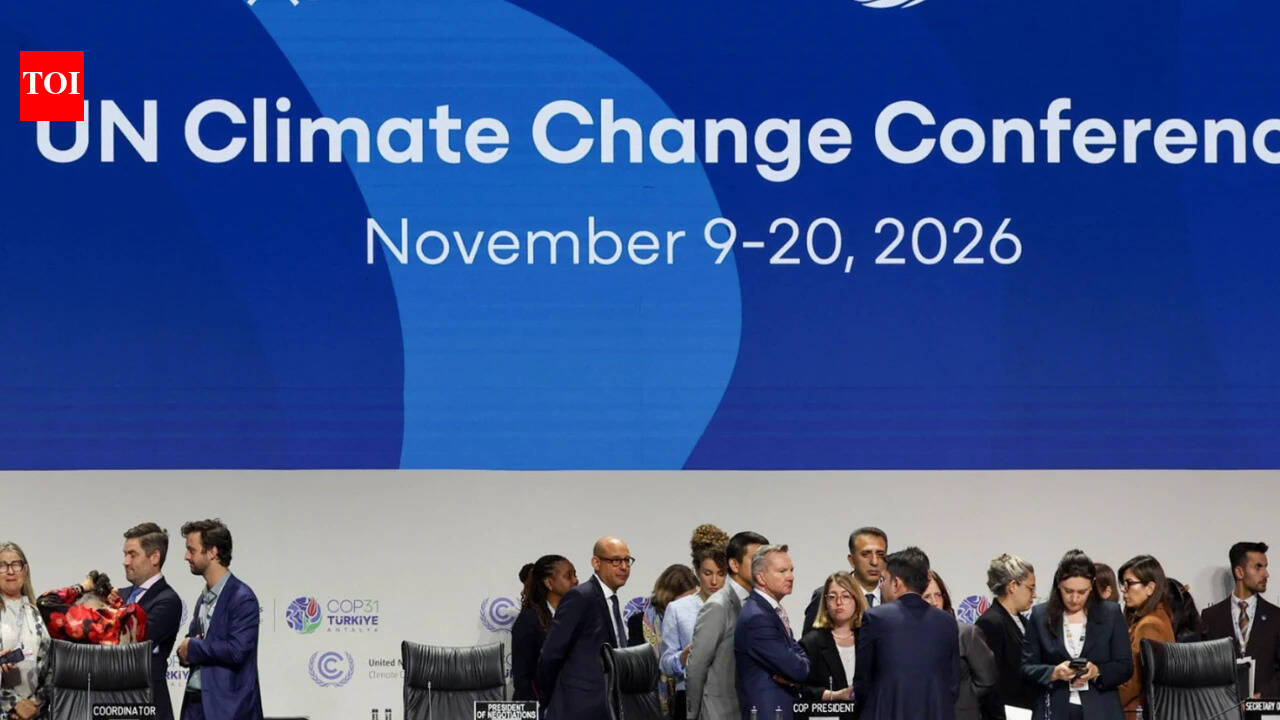
The EU, the UK and allies in developing countries rejected what they called an unacceptable deal on the future of the climate, which failed to even mention fossil fuels, at the dramatic conclusion of the Cop31 UN talks in Turkey.
The proposed agreement “fails to meet this deadline”, said the Irish environment minister, Darragh O’Brien, on behalf of the EU. “We will not allow a decision that does not respond to science and risks deepening the gap between global commitments and the necessary action.” [It] it doesn’t even mention fossil fuels.”
As the negotiations, scheduled to end on Friday, continued on Sunday afternoon in the longest climate conference ever, it became clear that the “Antalya agreement”, which was organized by the joint presidents of Turkey and Australia of the conference, will not achieve the necessary consensus to pass.
The Antalya agreement calls on countries to electrify their economies, calls on rich countries to provide finance to the poor to help them adapt to the impacts of severe climate change, and calls on countries to reduce the “overshoot” of the 1.5C global warming limit of the Paris agreement.
But it failed to enact the “transition away from fossil fuels” demanded by more than 130 countries, and included controversial provisions on “carbon capture and storage” (CCS) technology that some say fuels fossil fuels.
The presidents avoided a total collapse of the “conference of parties” by issuing decisions on a variety of related issues, including a “fair transition” to help workers in high-carbon industries transition to a low-carbon economy.
But Murat Kurum, the Turkish Cop president, admitted that there was no agreement on the text of the “cover resolution” and therefore it was not accepted.
“We did our best; in the end, we did not force this document on anyone, and we did not issue a ‘take it or leave it’ order,” he said. “It is clear that there are groups in this hall that oppose this document. We realize that there is no consensus on this document. Therefore, these decisions have not been accepted.”
Many countries, including the EU, the UK and developing countries including small island regions and other very poor countries, said they could not support the Antalya agreement, which was supposed to be the main result of Cop.
In a dramatic intervention, O’Brien said on behalf of the EU that he could not accept the final text in its current form. “It fails to meet this deadline … we will not propose a cover resolution or an Antalya agreement that would even mean burning the ground, which is the main cause of climate change.” He said the EU would no longer accept the decision to “burn fossil fuels”.
His intervention was met with applause in the hall, and was later followed by similar objections from Panama, the Marshall Islands and Norway.
“This feels like a real line in the sand. Countries are against fossil fuel interests and they’re saying no,” said Bill Hare, chief executive of the advisory group Climate Analytics.
But Mohamed Adow, the director of the thinktank Power Shift Africa, who called it “the worst cop ever”, said: “The EU has rejected this document, but it cannot wash its hands of the danger it helped create… In countries facing failed harvests, destroyed homes and growing debts, this is similar to the rejection of rich nations that are facing this crisis.
Their governments are looking for fuel road maps from other people while they are expanding fossil fuels.
Saudi Arabia has defended the decision to include the CCS in the text. Other countries, including the African group, China and Pakistan, also did not object to this agreement, although others were skeptical. Pakistan told the conference that just because a few things in the deal were unpopular with some, others should not be sacrificed: “Climate action is not a menu from which we can only choose what suits us.”
after the promotion of the newsletter
Ghana was also criticized for this plan but did not reject the final text which says: “Africa has always chosen to build a diverse nation rather than moving away from it.”
Nearly 200 countries met in Antalya for two days under the joint presidency of Turkey and Australia, with previous talks marked by long periods of tension as countries failed to reach consensus.
Cop president, Australia’s climate change minister, Chris Bowen, defended his leadership. “Australia left nothing on the field,” he said, but the red lines the presidents tried to negotiate were “uncrossable”.
Asked about the consensus-based system that has broken down in the negotiations, Simon Stiell, executive secretary of the UN Framework Convention on Climate Change, said: “It is certainly coming down today,” while stressing that a significant number of agenda items were passed, “with real progress and concrete results”.
But for many participants, these discussions exposed the failure of democracy, especially of the rich world, to address the urgency of climate change.
While extreme weather around the world has worsened this year, killing tens of thousands of people in heat waves, in disasters such as avalanches in Nepal, and in droughts and floods that have worsened as a result of El Niño in full swing, the slow pace of climate talks has shocked even those who have been involved.
“There is no sense of urgency to address these issues.” That to me is very frustrating,” said Mary Robinson, the former president of Ireland and a former UN envoy, as the talks neared the end of what was planned to be held. “We have presidents who have not stood up and given that leadership.”
The UN Secretary-General, António Guterres, said: “I am deeply disappointed that Cop31 ended without agreement with a disappointing outcome. I share the great frustration of all those who expected governments to step up to the climate demands. But this setback does not change the facts. There may not be a consensus on the negotiation floor.”
Source link