‘Once you’re in, there’s no getting out’: what the Falklands’ oil plans mean for its seals, whales and penguins | Falkland Islands

From the air, the large Falkland Islands form two large, rugged ridges against the South Atlantic. East Falkland and West Falkland are surrounded by 778 small islands and islets east of the southern tip of Patagonia.
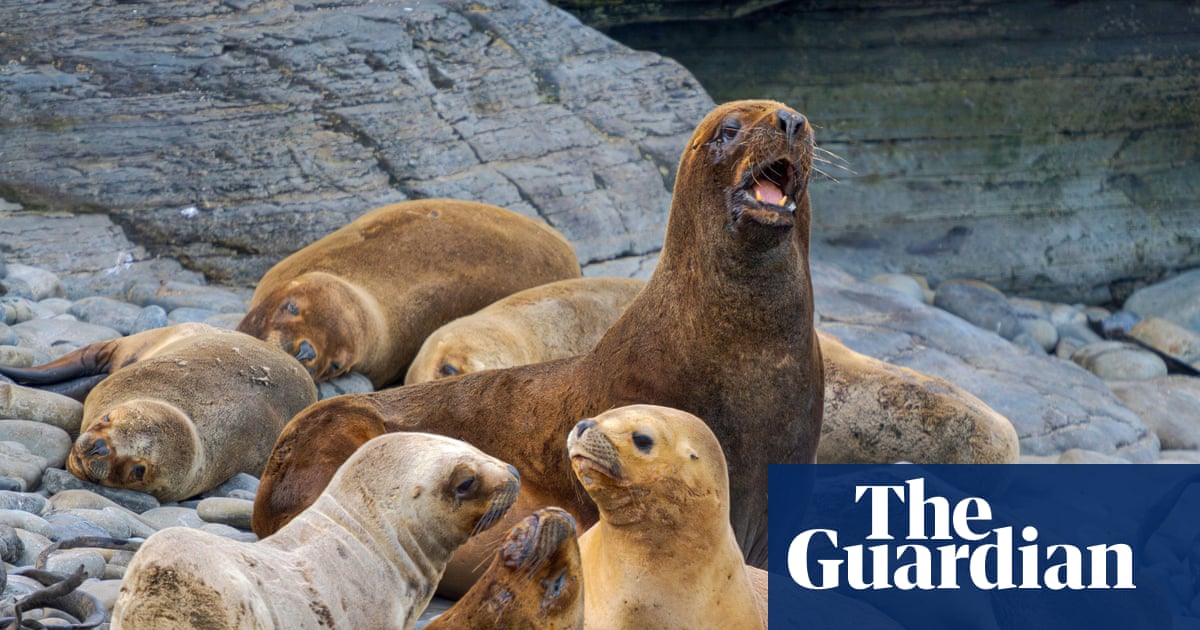
The archipelago, a British overseas territory claimed by Argentina, is home to large colonies of albatrosses and penguins. Its waters, along with those of the Patagonian shelf, provide feeding grounds for sea lions, southern elephant seals and southern right whales.
“We are talking about a very important place for wildlife, not only in the region but globally,” said Hernán Pérez Orsi, oceanographer, activist. and energy coordinator for the Patagonian Marine Conservation Forum.
However, new oil development projects licensed by the Falkland Islands government now threaten these waters: about 130 miles (210km) north of the islands is the Sea Lion project, a deep-water oil development that may involve drilling wells and installing subsea infrastructure in the sea.
Operated by Navitas Petroleum, and Rockhopper Exploration, the project plans 23 wells in its first two phases. The oil will be processed and stored on board the Aoka Mizu, a production vessel with a planned capacity of up to 55,000 barrels per day.
The estimate of the Sea Lion and its potential impacts on the environment concerns the Argentine Association of Environmental Lawyers (AAdeAA). Noting that normal activities may cause pollution in the sea, Gonzalo Vergez, the organization’s legal coordinator, says: “It is often said that oil operations on the coast cause damage, even when there is no fault.”
Warnings have also been issued to the residents of these islands. In August 2024, Falklands Conservation, a local environmental organization, asked for more scientific information on the Sea Lion, which was used in its environmental impact statement.
Its report notes that birds from colonies hundreds or thousands of miles away, including albatrosses from South Georgia and New Zealand, visit Falklands waters, and says the only seabird data that is widely relevant to the impact statement is more than 20 years old. According to Falklands Conservation, doing well in regions like the North Sea will require data collected within the last five years.
Oil exploration off the Falkland Islands is a new frontier in the South Atlantic rush carried out by countries across Latin America and the Caribbean since Brazil discovered its largest oil reserves to date in deep waters up to 300 miles offshore in the 2000s.
Although the British government has not provided direct financial support for the Sea Lion project, it is providing political, diplomatic and legal support. London insists that Falklands residents have the right to self-determination, including the right to manage their own natural resources.
Recently, Ellie Reeves, the attorney general of England and Wales, said the Falkland Islands would face “dire consequences” if the area was prevented from developing an offshore oil field.
The Patagonian shelf, on which the islands lie, is one of the most productive marine areas in the world, supported by the cold, nutrient-rich waters of the Falkland River. A 2019 study led by researcher Alastair Baylis estimated that the archipelago supports about three-quarters of the world’s black-browed albatross, half of the slender-billed prion and one-third of the southern rockhopper and gentoo penguin populations.
The researchers analyzed 1,891 foraging trips by 686 animals from nine seabird and marine mammal species. They identified areas where species overlap, particularly on the Patagonian shelf north of the Falkland Islands.
“Our findings highlight the distribution of marine predators on the Patagonian shelf [is] national power is not hindered,” the researchers concluded.
Besides the risk of a major accident, the Sea Lion’s potential environmental threats range from small oil leaks to underwater noise, drilling debris, industrial lights and shipping.
Oil spills can pose another danger: crude oil can poison animals and coat the feathers and fur of seabirds and marine mammals, disrupting their ability to regulate their body temperature. The Falklands Conservation report also questions spill risk assessment and risk response capacity.
The progress of the project has also prompted a response from the Argentine government, not for environmental reasons but against the backdrop of a long-standing sovereignty dispute with the UK. On September 3rd, the president of Argentina, Javier Milei, signed a decree strengthening the control of oil activities in the Falkland Islands without Argentina’s consent.
Although his government encourages large investments in energy, the law requires applicant companies and their affiliates to declare compliance with Argentine law governing oil and gas activities in the islands.
The next day, Argentina’s presidential office announced sanctions against 45 people and entities allegedly linked to those activities, including companies related to Navitas Petroleum and Rockhopper Exploration, according to Argentine newspaper La Nación.
However, environmental groups were monitoring oil activity in these waters long before the government responded. The AAdeAA, led by Enrique Viale, began investigating oil developments in the Argentine Sea in 2020 and has been examining information on Sea Lion since at least 2024.
As the project continued, it strengthened its work and, on 1 September, joined the La Plata Falkland Islands Ex-Combaants Center (CECIM), an organization of Argentine veterans of the 1982 war, in filing a legal action to prevent possible damage to the environment in an attempt to stop the development.
“Once this project is installed, there is no stopping it,” Viale said.
The dispute reached the Argentine courts. On September 16, federal judge Mariel Borruto ordered Navitas and Rockhopper not to carry out any work until an environmental assessment is carried out before the Argentine authorities, or until the court issues a different decision.
The order is still in force as of 29 October, although its application is uncertain: the islands remain under British administration, beyond the effective control of Argentina.
Beyond the sovereignty dispute and court rulings, questions remain about the project’s environmental impact. Rockhopper declined to comment, directing questions to the project’s operator, Navitas.
Navitas said he will not comment on these allegations until the International Tribunal for the Law of the Sea based in Hamburg has issued a decision on the case opened by the Argentine government against the UK, which says the Sea Lion project violates Argentina’s sovereignty and should be stopped. The court may issue a decision on November 28.
In its updated environmental impact statement from July 2025, Navitas acknowledged that some of the seabird survey data used was 24 years old, but argued that it remained useful for identifying broad distribution patterns and was supplemented by recent research.
While acknowledging that there are remaining data gaps, the company considers it unreasonable for an operator to repeat surveys at this level and suggests collecting more data as the project progresses.
The company is also aware of the potential impacts on marine wildlife even during normal operations. Its assessment rates residual impacts and risks related to artificial light, underwater noise, discharge of drilling rigs and ship collisions with cetaceans as “moderate”, despite proposed mitigation measures.
Navitas proposed vessel speed limits and the use of seabird and marine mammal monitors, while acknowledging that visual monitoring cannot prevent collisions in the dark. It rates its confidence in assessing the risk of collision as “uncertain”.
In the case of oil spills, the document also acknowledges the challenges of dealing with the harsh conditions of the sea in the south Atlantic: in one model case of the blowout of a subsea well, the recovery equipment was assumed to recover only 6.3% of the spilled oil, without reducing the estimated amount that reaches the shore.
As the Sea Lion project moves towards oil production, environmental groups are warning of the consequences for the richest marine areas in the south Atlantic.
For Vergez, the uncertainty provides all the more reason to act. He says: “If there is no scientific certainty, the principles of prevention and caution apply: protection is necessary.”
Source link